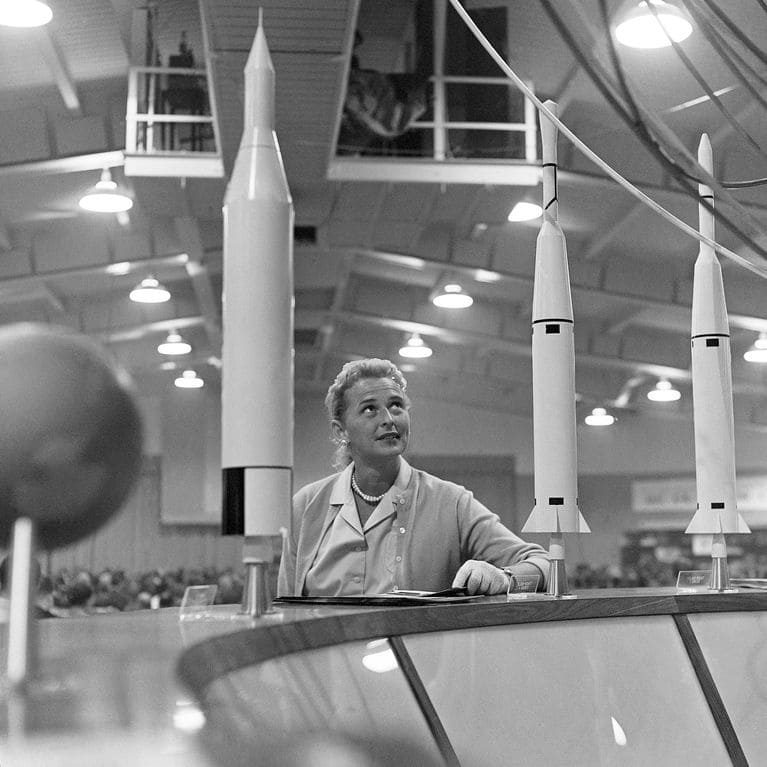
In 1961 JERRIE COBB was the first of 13 women pilots who passed the same torturous tests as the six other Mercury astronauts (male). In fact she scored in the top 2% of both the women and the men and had more hours as a pilot, and had set more records for speed and altitude than any of the others.
But then NASA changed the rules and stated only military pilots could qualify. Even John Glenn testified before Congress that women should not and could not be astronauts. So Jerrie Cob and the other women had to wait 33 years to see the first woman, Sally Ride, go into space.
Born in Norman, Oklahoma, March 5, 1931, the daughter of Army Lt. Col. William “Harvey” Cobb and Helena Stone Cobb, Geraldine “Jerrie” M. Cobb started flying at 12. She sat on a stack of pillows to see out and used blocks to reach the rudder pedals of her father’s open-cockpit Waco biplane. She was a natural. She passed her private license test at age 16, earned her commercial pilot’s license at age 18, and received her flight and ground instructor certificates one year later. She used money she earned playing professional softball to buy her first plane, a Fairchild PT-23.
Ms. Cobb went on to dust crops, deliver surplus military planes around the world, and work at the Oklahoma-based Aero Design and Engineering Co. in the 1950s, as one of the few female executives in aviation. “She found a way to work as a pilot, as a woman, at a time when all those jobs would have been listed in the newspaper under the title ‘Jobs for Men,’ ” said Margaret A. Weitekamp, a curator at the Smithsonian National Air and Space Museum and the author of “Right Stuff, Wrong Sex: America’s First Women in Space Program.”
In 1957 Ms. Cobb set world records for distance and altitude; followed in 1959 by the world record for speed. She was the first woman to fly in the Paris Air Show. Other awards included the Amelia Earhart Gold Medal of Achievement, the Amelia Earhart Memorial Award and in 1959, the National Pilots Association Pilot of the Year. By then she had drawn the attention of William Randolph Lovelace II, an aerospace medicine scientist who had helped select the Mercury Seven.
Before any human being had gone into space, Lovelace was already thinking about huge orbiting space stations — Disney television-show-style things - with dozens of people aboard doing scientific research and reconnaissance. In Lovelace’s view, women were to function as an essential part of such space stations, working as secretaries or nurses. To determine whether they would be able to survive in space, he invited Ms. Cobb, then 28, to perform the same tests he had used on the Mercury astronaut candidates.
After Lovelace announced in a Stockholm news conference that Ms. Cobb had aced the testing program, scoring in the top 2 percent of pilots and bettering many of her male colleagues, public interest in a female astronaut program began to grow.
Ms. Cobb helped Lovelace and his collaborator, Air Force Brig. Gen. Don Flickinger, select additional pilots for their Woman in Space Program, poring over flight records to identify promising female aviators. With support and funding from Jacqueline Cochran , the first woman to break the sound barrier, 19 female pilots took the tests. In addition to Ms. Cobb, twelve more passed with “no medical reservations,” forming a cohort that Ms. Cobb described as the First Lady Astronaut Trainees, or FLATs. But the program was disbanded in late summer of 1961, after a Navy aviation school in Pensacola, Fla., barred Lovelace from using its spaceflight testing facilities without official permission from NASA.
Ms. Cobb became the country’s most prominent supporter of female astronauts, seeking to overturn a NASA provision that required all astronaut candidates to have experience flying military jets — an opportunity that was closed to women.
Working with Jane B. Hart, a fellow FLAT and the wife of Sen. Philip Hart (D-Mich.), she attended a House subcommittee hearing, where she testified that female pilots were “not trying to join a battle of the sexes”. “We seek only a place in our nation’s space future without discrimination,” she said, two years before the Civil Rights Act of 1964 outlawed sex discrimination.
Ms. Cobb’s testimony was followed by that of astronauts such as Glenn, who had recently become the first American to orbit the Earth. “The men go off and fight the wars and design the airplanes and come back and help design and build and test them,” he said. “The fact that women are not in this field is a matter of our social order. It may be undesirable.”
By that time, NASA’s focus had shifted entirely to putting a man on the moon, and agency officials said that redesigning flight suits for female astronauts would be costly and time-consuming in the midst of the Space Race. The milestone of sending the first woman to space was left to the Soviet Union, which launched Valentina Tereshkova in 1963. The first American woman in space, Sally Ride, followed suit in 1983.
By then Ms. Cobb had established herself as a missionary and humanitarian in South America, where she had once delivered military planes to Peru and spent days in an Ecuadoran prison, accused of being a spy for Peru. She flew solo with the aid of hand-drawn maps and for her work she was honored by the governments of Brazil, Colombia, Ecuador and Peru.
“The only thing that would take her away from her work”, she said, “was another chance to go into space” — an opportunity that presented itself in 1998, when Glenn, then 77 and a U.S. senator, became the oldest person to fly in space.
A grass-roots campaign to “Send Jerrie Into Space” was launched on behalf of Ms. Cobb, who was then 67 and received support from groups including the National Organization for Women. Traveling to Washington, she met with Glenn and later with NASA Administrator Daniel Goldin, calling for more female astronauts regardless of whether she made it into space. “If they think it’s important to study an older man,” said the 67-year-old Cobb, “I can’t see why it’s not important to study an older woman.”
Her mission never came to pass. But Ms. Cobb was there at the launchpad in July 1999, watching alongside other surviving FLATs as Eileen Collins became NASA’s first female shuttle commander. Four years earlier, when Collins became the first female pilot of a shuttle, she launched into space carrying a token from Ms. Cobb: a gold pin in the shape of a Colombian bird, a symbol of the plane she flew in South America.
Geraldyn “Jerrie”M. Cobb is enshrined in the National Aviation Hall of Fame.
(photo by William P. Straeter AP)