Reproaction is a left-flank culture change organization with deep chops in strategic communications, fearless opposition research, and community organizing, including but not limited to non-violent direct action.
Tag: "#about women"

PLEASE! PLEASE!
READ THIS & SHARE
On November 11th (Veterans Day) I attempted to post a tribute to our veterans. Partway through my effort, Facebook blocked me on the grounds I was sharing with too many groups. Now they will not let me share at all.
I am a member of all the groups I share with and have been anywhere from several months to almost two years each. During this whole time, I have never received a single complaint from any of the groups’ administrators. I have not and will not engage in posting material that violates rules of decency.
For now I am unable to share posts with your group and I do not know how long this situation will continue. To receive what I post, you may do one or more of the following.
- Go to womensvoicesmedia.org and subscribe to our newsletter.
- Check back regularly to Facebook.com/Womens-Voices-Media/ and read the posts there.
- Follow me on Facebook.com/Womens-Voices-Media/ to receive notices of posts.
- Follow me on twitter @MediaWomans
AND PLEASE: SHARE, SHARE ,SHARE freely and everywhere.
Thank you
Dare to Run is a 501 (c) 3 nonprofit organization whose mission is to educate and empower women with the skills necessary to run for public office at the local, state and national level of government.
We offer women candidates the chance to participate in a one-year certificate program in pursuit of a career path in public service. Dare to Run gives women the opportunity to be a voice for their communities by committing to run campaigns in search of elected office within two years of graduation from the program.
Dare to Run’s mission is to provide women with the skills they need to be successful during the campaign and throughout their term in office by:
- Teaching women the history of women’s public participation in the United States since its inception
- Coaching women to use their voices to effect public policy change and champion issues of importance to their communities
- Instilling the fundamentals of successful campaign management, with an emphasis on successful fundraising strategies for women candidates
Cultivating a new generation of female public servants who value their constituents and use their tenure in office to serve the needs of their community as best they can
The core values of Dare to Run are highlighted in the following five principles:
- Equality - Women should have an equal say in the development of the public policy agenda at the local, state and national levels of government
- Collaboration - Women should work together to achieve a higher quality of life for all constituents in their community
- Opportunity - Women should have equal opportunities to run for public office; they should not be hindered because of race, religion, ethnicity, disability, socioeconomic status, or sexual orientation
- Diversity - Women should hold at least 50% of the seats at all levels of government, and the demographic breakdown of the population of the United States should be reflected in the composition of governing bodies at the local, state and national levels of government.
- Respect - Women should value the viewpoints of other women, and offer support, sorority and a moral high ground on which to effect change for the rest of the country.

Female Genital Mutilation or Cutting (FGM/C)
From a U.S. Government fact sheet.
FGM/C refers to cutting and other procedures that injure the female genital organs for non-medical reasons. It maybe called “female circumcision” in certain parts of the world. The practice has no health benefits and can lead to a range of physical and mental health problems.
Immediate effects may include blood loss, severe pain, and sometimes death. Long-term health problems can include urinary infections, fistula, infertility, painful menstruation or sexual intercourse, and a potential increase in the risk of HIV/AIDS infection. In addition, women who have had FGM/C are significantly more likely to experience difficulties during childbirth and their babies are more likely to die as a result of the practice. Finally, the practice often leaves girls and women feeling scared, psychologically scarred, embarrassed, and distressed.
A Public Health Report on Women and Girls at Risk for Genital Mutilation in the U.S.
Objectives. In 1996, the U.S. Congress passed legislation making female genital mutilation/cutting (FGM/C) illegal in the United States. CDC published the first estimates of the number of women and girls at risk for FGM/C in 1997. Since 2012, various constituencies have again raised concerns about the practice in the United States. We updated an earlier estimate of the number of women and girls in the United States who were at risk for FGM/C or its consequences.
Methods. We estimated the number of women and girls who were at risk for undergoing FGM/C or its consequences in 2012 by applying country-specific prevalence of FGM/C to the estimated number of women and girls living in the United States who were born in that country or who lived with a parent born in that country.
Results. Approximately 513,000 women and girls in the United States were at risk for FGM/C or its consequences in 2012, which was more than three times higher than the earlier estimate, based on 1990 data. The increase in the number of women and girls younger than 18 years of age at risk for FGM/C was more than four times that of previous estimates.
Conclusion. The estimated increase was wholly a result of rapid growth in the number of immigrants from FGM/C-practicing countries living in the United States and not from increases in FGM/C prevalence in those countries. Scientifically valid information regarding whether women or their daughters have actually undergone FGM/C and related information that can contribute to efforts to prevent the practice in the United States and provide needed health services to women who have undergone FGM/C are needed.
The entire report can be read here:
https://www.uscis.gov/sites/default/files/document/reports/fgmutilation.pdf
FGM is recognized internationally as a violation of the human rights of girls and women. It reflects deep-rooted inequality between the sexes, and constitutes an extreme form of discrimination against women. It is nearly always carried out on minors and is a violation of the rights of children. The practice also violates a person's rights to health, security and physical integrity, the right to be free from torture and cruel, inhuman or degrading treatment, and the right to life when the procedure results in death.
Yet FGM/C occurs on almost every continent. The United States is no exception. One estimate is that as many as half a million girls and women have been victims of this form of violence or are at risk of being victims. Most victims were born in countries where FMG/C is rooted in cultural beliefs or who live with a parent born in one of these countries.
The burden of preventing FGM/C falls largely on law enforcement but this presents significant challenges. Affected women and girls are difficult to identify and may not come in contact with law enforcement. Women who had the procedure when they were very young may not even recognize they are victims. (This procedure may be done on females as early as infancy.) Fearing condemnation and harassment from their families and communities, many girls and women will not seek help and/or deny it if asked.
This form of violence against women and girls is such a complicated issue, it is going to take the co-operation of many agencies beginning with education and understanding. We all have to see and understand the problem to deal with it successfully.
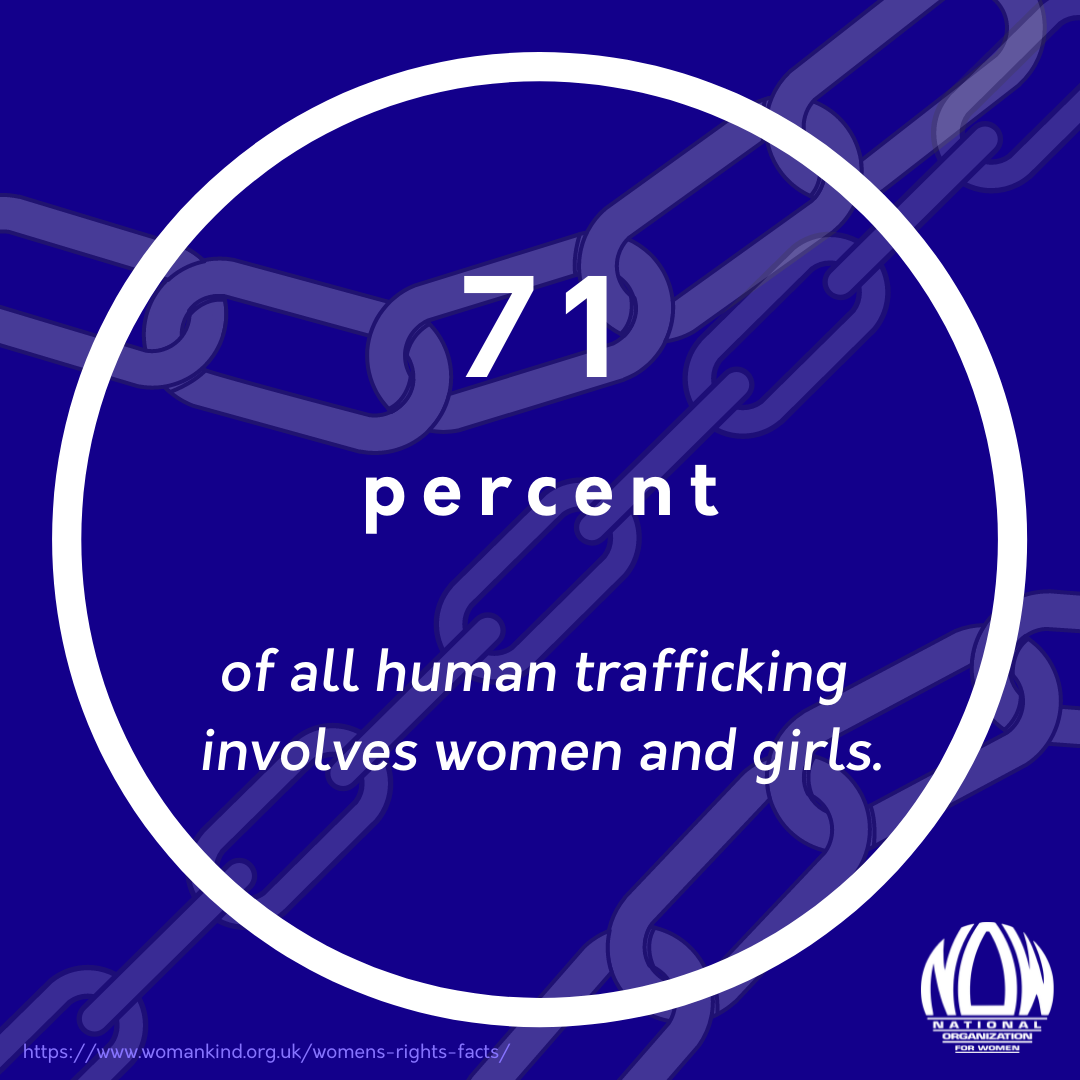
Did you know? 71% of all human trafficking involves women and girls. This is why we need VAWA (Violence Against Women Act). We need protections in place to end gender-based violence. The National Human Trafficking Hotline (1-888-373-7888) has identified more than 47,000 cases of human trafficking across the United States since the phone lines opened in 2007.
Perhaps you are not aware human trafficking is a pervasive problem spanning all across the United States and indeed all across the world. Consider this: Recently law enforcement in 12 states conducted a coordinated sex trafficking bust. Over 100 were arrested and 47, including 2 minors, were rescued and given medical treatment.
Learn more about human trafficking and what signs to look for , or if you need help: go to https://humantraffickinghotline.org/