The Black Women Veterans of World War II Fought for More than the "Double V"
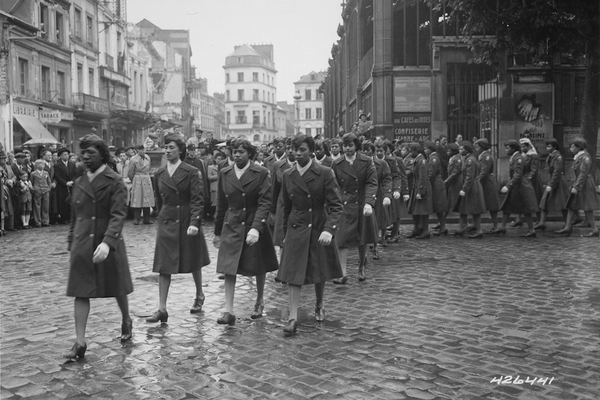
Editors Note: According to the National Archives 6,520 African American women served in WW II. Retired Army Col. Edna Cummings has said, “I believe that people are aware that Black women served during World War II, but I do not believe they know the full scope of their service.”
Despite their facing segregation and discrimination and given the worst jobs to do, African American women served their country honorably and well. So HERSTORY begins its’ celebration of Black History Month by honoring the Black women veterans of World War II.
**************************************************
During World War II, Black newspapers rallied African-Americans behind the “Double Victory” campaign to fight the war against ethnic oppression abroad as well as racial oppression at home. But the African-American women who served during this time also had a third enemy – the one that held them back because of their gender.
The Double Victory campaign was inspired by a letter published in the Pittsburgh Courier on January 31, 1942 entitled “Should I Sacrifice To Live ‘Half-American?” In the letter, James G. Thompson explained that the first V was “for victory over our enemies from without” and the second V was “for victory over our enemies from within.” The paper would later proclaim “this slogan as the true battle cry of colored America.” The Pittsburgh Courier debuted its Double V logo the next week in the February 7 edition, and would continue to print it as part of its masthead for the remainder of the war.
Meanwhile, Massachusetts Congresswoman Edith Nourse Rogers was hard at work on a bill to create a women’s branch of the U.S. military. Many women had served as volunteers during World War I but were not eligible for veteran’s benefits since they had not been official members of the U.S. military. Rogers wanted to make sure that this did not happen again during this new war.
Once the Women’s Army Auxiliary Corps (WAAC, later WAC) was established, Mary McLeod Bethune went into action. Bethune was the head of the Negro division of the National Youth Administration as well as founder of what is now Bethune Cookman University. She was also an advisor to four presidents, including President Franklin Roosevelt. She had seen how Black young people, especially Black women, struggled to find good jobs during the Great Depression of the 1930s. With her access to the highest reaches of the U.S. government, she used her influence to ensure that Black women would be able to have meaningful opportunities within the WAAC. Ones that would position them to be eligible for those educational and professional veteran’s benefits too.
In general, the women who joined the WAC were subjected to sexist assumptions about their virtues and ability to make meaningful contributions to the war effort as a part of the military. Male soldiers and officers were vocal about their beliefs that women had no place in the service. Inside and outside of the military, a common assumption was that these women had enlisted so that they could “service” the male service members. They were not issued weapons nor given any weapons training – even when ordered into hostile areas – because brandishing a gun was considered “unladylike.” However, the Black women who served had to deal with a unique set of challenges.
These challenges included being subjected to double segregation. Black men in the military were segregated only on the basis of their race. Black women were separated by their race and gender. To get into the WAC, a woman had to meet high standards of morality and femininity; white women might be able to loosen up a little once they were officially in. But Black women had to meet the highest of these standards at all times. Even when they continued to maintain those standards, they were more often than not perceived as only capable of performing domestic duties despite their educational and professional backgrounds.
The stripes that the Black female officers wore made them even more of a target. It enraged some members of the American public that a white soldier who held a lower rank was expected to salute these women and follow their orders. This led to Black female officers experiencing encounters with the police because they were assumed to be imposters and worse. One was hospitalized after being beaten up on a train platform in Tennessee.
However, despite these unique challenges, Black female soldiers fought back in creative ways. They used the power of their personal connections and of the Black press to overturn discriminatory policies and practices, such as having the “Colored” signs removed from the mess hall tables during the first WAAC officer training class. They studied Army policies until they knew them backwards and forwards. So when Major Charity Adams responded “Over my dead body, sir” to a general’s threat to have her replaced after refusing his frivolous order, she had the documentation to back her up when he attempted to have her court martialed. They even went as far to stop work, effectively going on strike, when pigeonholed into intolerable working conditions at the Fort Devens Hospital in Massachusetts in 1945.
Despite these extra burdens, Black women who served in the WAAC/WAC during World War II went on to distinguish themselves. The 6888th Postal Battalion Directory was given the “impossible” task of getting the backlog of mail moving in six months. They cleared the backlog in three. Black female officers trained all of the Black women who enlisted in the corps. They showed the top brass what Black women were capable of achieving, if only given a chance.
Kaia Alderson's debut historical novel Sisters in Arms: A Novel of the Daring Black Women Who Served During World War II was published in August by William Morrow/Harper Collins and was named November's selection for Stephen Curry's book club.