FLORENCE NIGHTINGALE (1820-1910)
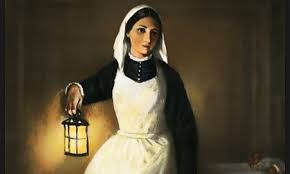
Nightingale was born May 12, 1820, in Florence, Italy. As a member of an affluent British family she was afforded a classical education, including mathematics, German, French and Italian. Her early philanthropic work caring for the ill and poor people in the village neighboring her family’s estate, led her to believe that nursing was her calling.
Young women of her era were expected to get married and raise a family while engaging in the pursuits that only women of her status would properly engage in. When she told her family about her desire to be a nurse, she met with great displeasure and was forbidden to pursue any training. She turned down a marriage proposal from a suitable gentleman and eventually enrolled as a nursing student in 1850 at the Institution of Protestant Deaconesses in Kaiserworth, Germany.
On her return to London she took a nursing job at a Harley Street hospital for ailing governesses. So impressive was her work there that she was promoted to superintendent. During this same period she volunteered at a Middlesex hospital which was dealing with a cholera outbreak and unsanitary conditions contributing to the spread of the disease. It was there she tackled the problem of hygiene practices and significantly lowered the death rate in the process.
Nightingale came to prominence when, in late 1854, British Secretary of War Sidney Herbert wrote her a letter asking her to organize a corps of nurses to care for soldiers wounded in the Crimean War. She gathered 38 nurses, trained them and set sail for Scutari, the British base hospital in Constantinople. Though they had been warned of the horrible conditions there, they were not prepared for what they saw. Personal hygiene for the patients was virtually non-existent and the hospital sat on top of a cesspool which contaminated the water and the building. More soldiers were dying from infectious diseases than from the wounds they incurred in battle.
Just as Nightingale had done in the Middlesex hospital, she made it her mission to improve the hygiene practices and achieved significantly lower death rates of the soldiers. She procured hundreds of scrub brushes and enlisted the aid of everyone she could to clean the hospital from top to bottom. She endeared herself with her constant care and compassion. Soldiers began calling her “the Lady with the Lamp” because of her endless rounds caring for patients at night while carrying a lamp. Others called her “the Angel of the Crimea”. In addition to her nursing duties during the year and a half she was there, she created an “invalid kitchen” for preparing food for patients with special dietary needs, a laundry so patients had clean linens, and a library.
Much to her surprise she was greeted as a hero when she returned home in Lea Hurst. In honor of her work Nightingale had already received from Queen Victoria an engraved brooch and a prize from the British government of $250,000. She decided to use that money to further her cause and in 1860 funded the establishment of St. Thomas’ Hospital. Within the hospital was the Nightingale Training School for Nurses. Many young women, even wealthy ones, admired her work and were now most anxious to follow in her footsteps.
While at Scutari, Nightingale contracted the bacterial infection brucellosis and would never fully recover. By age 38 she was homebound and often bedridden. She continued her work right from her bed. Considered an authority and advocate on healthcare reform, she consulted right from bed with politicians and other distinguished visitors. In 1859 she published “Notes On Hospitals” on how to properly run civilian hospitals.
Nightingale passed away suddenly on August 13, 1910. She was 90 years old.
The Florence Nightingale Museum, housing more than 2,000 artifacts commemorating her life and career, sits on the site of the original Nightingale Training School for Nurses. It stands as a tribute to the woman revered as the mother of modern nursing.
#womensvoicesmedia