HomeYour VoiceHerStoryYour MultimediaResource LibraryAbout WVMCode of ConductRegisterLog in

  • Latest Post
  • Post index
  • Archives
  • Categories
  • Latest comments
  • Contact
  • Post Something
  • « Mary Church Terrell (1863-1954)
  • Yo-Yo Ma, Alison Krauss - The Wexford Carol (Video) »

WHAT IS THE NATIONAL POPULAR VOTE ? (NPV)

WHAT IS THE NATIONAL POPULAR VOTE ? (NPV)
Posted by jj on Dec 06, 2019 in Editor Byline
WHAT IS THE NATIONAL POPULAR VOTE ?   (NPV)

The National Popular Vote (NPV) plan guarantees election of the presidential candidate who receives the most popular votes in all 50 states and the District of Columbia. The NPV plan is a state statute in the form of an interstate compact. It creates an agreement among states to award all of their electoral votes collectively to the presidential candidate who wins the national popular vote. This agreement takes effect only once the participating states together hold a majority of electoral votes (270 of 538)--guaranteeing that the winner of the national popular vote will win an Electoral College majority.

Passing NPV will guarantee election of the national popular vote winner once the compact has been joined by enough states to make it decisive for determining the outcome of future elections. Until that point, a state’s current rules apply.

State legislators have introduced NPV legislation in all 50 states and the District of Columbia. NPV legislation has now been enacted by 11 jurisdictions possessing 165 electoral votes, or 61% of the 270 electoral votes needed to activate the compact. 

Why is this so important?

Take a look at the following excerpt from the website www.nationalpopularvote.com.

The National Popular Vote Interstate Compact will guarantee the Presidency to the candidate who receives the most popular votes across all 50 states and the District of Columbia. The Compact ensures that every vote, in every state, will matter in every presidential election. The Compact is a state-based approach that preserves the Electoral College, state control of elections, and the power of the states to control how the President is elected.

The National Popular Vote bill has been enacted by 16 jurisdictions possessing 196 electoral votes, including 4 small states (DE, HI, RI, VT), 8 medium-sized states (CO, CT, MD, MA, NJ, NM, OR, WA), 3 big states (CA, IL, NY), and the District of Columbia. The bill will take effect when enacted by states with 74 more electoral votes.  The bill has passed at least one chamber in 8 additional states with 75 more electoral votes (AR, AZ, ME, MI, MN, NC, NV, OK).  A total of 3,408 state legislators from all 50 states have endorsed it.

The shortcomings of the current system of electing the President stem from “winner-take-all” laws that have been enacted by state legislatures in 48 states. These laws award all of a state’s electoral votes to the candidate receiving the most popular votes in each state.

Because of these state winner-take-all statutes, presidential candidates have no reason to pay attention to the issues of concern to voters in states where the statewide outcome is a foregone conclusion. In 2012, as shown on the map, all of the  253 general-election campaign events were in just 12 states, and two-thirds were in just 4 states (Ohio, Florida, Virginia, and Iowa). Thirty-eight states were completely ignored.
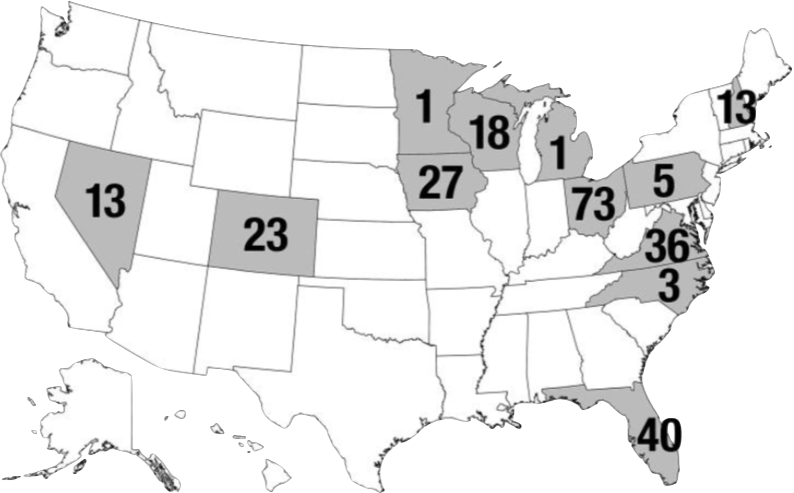
Campaign Events in 2012


Original post blogged on Women' Voices Media.

Tags: equal representation


Form is loading...

Women's Voices Media

Women's thought, women's opinions, women's facts presented in a feminist point of view. We endorse works that present in an empirical and logical style.

Search

Categories

Women's Voices Media

  • Editor Byline
  • Home Page
  • Intro
  • Newsworthy

Your Voice

  • Background
  • ERA and CEDAW
  • Economic Justice
  • Education
  • Elections
  • Environment
  • Equal Representation
  • Health and Safety
  • Intersectional Issues
  • Intersectional Issues
  • Intro
  • Judicial System
  • My Voice
  • Politics & Elections
  • Reproductive Rights
  • Social Justice
  • Tech
  • Violence

HerStory

  • Background
  • Intersectional Issues
  • Social Justice
  • Women In Education
  • Women In Politics
  • Women In Science, Technology, & Math (STEM)
  • Women In Sports
  • Women In the Arts
  • Women In the Law
  • Women Not Categorized
  • Women in Business
  • Women's Health & Reproductive Rights
  • Womens Rights

Your Multimedia

  • Art
  • Background
  • Events
  • Intersectional Issues
  • Just Interesting
  • News
  • People
  • Welcome

Women's Resource Library

  • Current News
  • Diverse / Uncategorized
  • ERA and CEDAW
    • CEDAW
    • ERA
  • Environment
    • Air / Atmospheric Polution
    • Alternate Power Sources
    • Climate Change
    • Destruction of Forests and Habitats
    • Sustainability
    • Water Resources
      • Fracking
      • Waste Disposal
  • Equal Representation
    • In Business and Corporations
    • In Education (K-20)
    • In Government
    • In Law Enforcement
    • In Sports
    • In the Justice System
    • Science, Technology, Engineering, and Math (STEM)
  • Equality and Justice
    • Ableism
    • Ageism
    • Child Care
    • Economic Equality
    • Homelessness
    • LGBTQA Discrimination
    • Poverty and Hunger
    • Racism
    • Sexism
  • Gender Studies
  • General Science
  • Girls & Young Women
  • Health and Safety
    • HIV / AIDS
    • Health Insurance
    • Maternal and Infant Care
    • Medical Research
    • Paid Sick and Parental Leave
    • Pregnancy Accommodations
    • Sex Transmitted Diseases
    • Substance Addiction and Abuse
      • Opioid Crisis
      • Physician Over-prescription
  • Herstory
  • Independant Media
  • Politics
  • Reproductive Rights
    • Abortion Rights
      • Roe v. Wade
    • Contraception
  • The Arts
  • Violence
    • Ableism
    • Child Abuse
    • Date Rape
    • Domestic Violence
    • Elder Abuse
    • Genital Mutilation
    • Gun Safety and Control
    • Harrassment
    • LGBTQA - Abuse and Assault
    • Racism
    • Rape / Assault
    • Sex Trafficking / Sex Slavery
    • Women In Prison
  • World Issues

XML Feeds

  • RSS 2.0: Posts
  • Atom: Posts
What is RSS?

Women's Voices Media
This collection 2026 by Janice Jochum
Copyright 2019 United Activision Media, LLC
This work is licensed under a Creative Commons Attribution-NonCommercial 4.0 International License.
• Contact • Help • Build your own site!

Website engine
Cookies are required to enable core site functionality.