Heather Booth (1945 - )
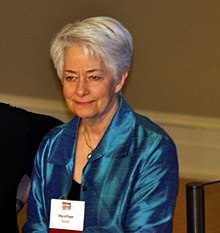
Heather Booth (born December 15, 1945) is an American civil rights activist, feminist, and political strategist who has been involved in activism for progressive causes. During her student years, she was active in both the civil rights movement and feminist causes. Since then she has had a career involving feminism, community organization, and progressive politics.
Early life and family
Booth's father, Jerome Sanford Tobis (1916–2012), was a physician who specialized in physical therapy and cardiac rehabilitation.[1][note 1] Her mother, Hazel Victoria Weisbard Tobis (1918–2002),[4] was a special education teacher.[5]: 104 Although Hazel Weisbard was her high school's valedictorian, her parents forbid her to accept a scholarship to attend college.[2] Once her three children were grown, she went back to college and obtained bachelor's and master's degrees.[6]
Booth was born in a military hospital in Brookhaven, Mississippi, on December 15, 1945, during a period in which her father was serving as an Army doctor.[5]: 104 [6] Soon after her birth, her family moved to Bensonhurst, Brooklyn, where she received her elementary education in P.S. 200 in the Bath Beach neighborhood. Later, she attended high school in Long Island's North Shore after her family had moved to that upscale area.[7] She has two brothers, David and Jonathan.[5]: 105 Booth grew up in a warm, loving, and supportive family. Her parents taught her the importance of recognizing injustice and acting to correct it.[6] They were observant Jews, belonging to a liberal synagogue, who showed by example the importance of treating others with decency and respect.[2] From her Jewish upbringing, Booth learned to take on responsibility for building a society that reflected these goals.[8][note 2]
After her family had moved to Long Island, Booth's mother, using Betty Friedan's The Feminine Mystique, made her aware of the growing discontent of prosperous suburban housewives with the conventionally narrow lives they led.[2] In high school, Booth joined a sorority and the cheerleading team but left both of them when she came to believe that their members were discriminating against students who did not lead their privileged lives.[2] She began leafleting against the death penalty. In 1960, she joined CORE in a protest against the segregationist policies of the Woolworth's chain.[9] Upon graduating from high school in 1963, she spent the summer traveling in Israel and that fall enrolled as a freshman at the University of Chicago.[7] She chose that school in part because it had no sororities and deemphasized sports.[10] In college, she quickly immersed herself in political activism.[2] In 1967, she received a Bachelor of Arts degree in social sciences, then in 1970, a Master of Arts degree in educational psychology, both from the University of Chicago.[6]
She and Paul Booth married in July 1967, shortly after she graduated from college.[10] They had met at a sit-in protesting the University of Chicago's cooperation with the policies of the U.S. Selective Service System whose local boards were then drafting men to serve in the Vietnam War.[11] Later that year, she was arrested during a protest at the U.S. Army induction center in Chicago.[12] The couple had two sons, Eugene Victor Booth (born in 1968) and Daniel Garrison Booth (born in 1969).[note 3]
One of the founders of Students for a Democratic Society (SDS), Paul Booth was national secretary of the organization when they met.[13] He helped organize the 1965 March on Washington for Peace in Vietnam,[14] subsequently became president of the Citizen Action Program in Chicago (a group formed in 1969 by members of Alinsky's Industrial Areas Foundation), and was later a director of the Midwest Academy.[15] Beginning in the 1980s, he held a series of positions within the American Federation of State, County and Municipal Employees union.[16] In 2017, by then executive assistant to the union's president, he retired, continuing his political engagement by supporting Heather Booth in her work.[17] He died January 17, 2018, from complications of chronic lymphocytic leukemia.[16][note 4]
Civil rights
Booth's opposition to racial discrimination began when she was still in elementary school. She defended an African-American fellow student who was being attacked for allegedly stealing another student's lunch money. It was soon discovered that the girl who made the accusation had put the money in her shoe and forgotten it. In a 1985 interview, Booth said "I remember having the feeling that you don't do this to people."[18] While in high school, she joined the Congress of Racial Equality (CORE) to help protest Woolworth's lunch counter discrimination in the South. In 1963, soon after enrolling in college, she became head of a group, called Friends of SNCC, that was organized on campus to support the Student Nonviolent Coordinating Committee.[11] She also became student liaison to the Chicago Council of Community Organizations (CCCO), which was then protesting school segregation in the city.[19] As CCCO liaison, she helped coordinate freedom schools in the Chicago's South Side.[6]
In 1964, Booth joined the Freedom Summer project in which volunteers from Northern and Western colleges and universities worked to register black voters and set up freedom schools and libraries in Mississippi.[13] She was arrested for the first time while she was carrying a sign saying "Freedom Now!" during a peaceful demonstration in Shaw, Mississippi.[20] In an interview conducted in 1989, she said that the experience reinforced her commitment to the civil rights movement. Confronted by the violent resistance of white Mississippians, she feared for her own life, but also realized that she could leave whenever she wished and was awed by the extraordinary heroism of the black residents with whom she worked. "They had a quiet heroism," she said, "not just by standing up to bullets, but by day to day being willing to go and talk to their neighbors, have meetings in their churches, take people into their homes." She said the work was full of tiring and frustrating tasks but recognized that it is the mundane everyday work that brings meaningful change.[6]
In 1965, Booth was arrested while demonstrating at banks that were providing financial support for the apartheid regime in South Africa.[11] Shortly afterward, she helped form a number of local groups that sought to learn about urban problems and find ways to overcome them.[10] She left SNCC in 1967 when its leaders no longer welcomed Whites as members.[21] She then devoted more of her time to issues related to feminism and the anti-war movement.[11]
Feminism
Soon after she arrived on campus, Booth ran up against the university's bias in favor of its male students. In 1965, she began to set up consciousness raising groups to deal with the problem.[2] These small groups of women met regularly to speak about incidents, both minor and more serious, that seemed to be unique but often proved to be shared. In a pamphlet published in April 1968, Booth and two co-writers noted a tendency for women to "see their problems as personal ones and thus blame themselves."[22][note 5] In discovering how many ostensibly unique concerns were actually common ones, members gained a sense of the collective influence they might exert toward changing the unfair practices and dismissive attitudes they had previously accepted as cultural norms.[23] She also helped to organize a course on women's studies, began to coach women who were uneasy about speaking up in class, and conducted a study on the disparity of treatment between male and female students in the classroom.[24] Noticing a similar unequal treatment among student activists, she founded a campus group, the Women's Radical Action Program, to document and counter the ways in which women were relegated to subordinate roles in national organizations such as Students for a Democratic Society and SNCC.[10][note 6] In 1967, Booth joined with other activists to form the Chicago West Side Group, which was reported to have been "the first women’s liberation group in the country, with the primary goal of raising the consciousness of its members."[25]
In 1965, a fellow student asked whether Booth could help his sister who was so greatly distraught about an unwanted pregnancy as to consider killing herself.[26] By contacting the medical arm of the civil rights movement, she was able to refer the woman to a reputable doctor who was willing to perform an abortion.[2][note 7] As word quietly spread throughout the university community she was asked to make more referrals to the same doctor. In complying, she made sure that he would not only treat them, but also make sure the patients made a successful recovery.[26] The Jane Collective, or simply Jane, emerged from this early start. Booth formed it by involving like-minded students in a clandestine organization for evaluating doctors, counseling women who contacted them, performing referrals, and conducting follow-up discussions by phone.[10] By 1969 this group, calling itself the Abortion Counseling Service of Women's Liberation, began to advertise in student and underground newspapers, advising pregnant women who needed help to "Call Jane."[26][note 8] The Jane Collective disbanded following the Roe v. Wade decision of the U.S. Supreme Court on January 22, 1973, which effectively legalized abortion throughout the country.[5]: 105
In 1969, recognizing the need to counter a strong tendency among feminists to see all organizational structures as oppressive, Booth joined with five other women to found the Chicago Women's Liberation Union (CWLU).[28][note 9] They believed that organization was essential for the movement be able to reach out to women who were not already radicalized and for it to develop strategies for winning reforms that would demonstrably improve women's lives. They said a structured approach was needed, including careful planning, the setting of specific goals, and developing strategies achieve these goals. Overall, they were committed to helping women to gain a sense of their collective power.[30] The CWLU organized local chapters, published newspapers, engaged in direct action, and ran a liberation school founded by CWLU's first staff member, Vivian Rothstein.[28][31]
After her marriage and the birth of her sons, Booth began to experience family-related issues that most feminist activists had considered to have little or no importance.[10] Finding no local child care centers in the Hyde Park community where she lived, she joined with two friends in an effort to set one up.[note 10] The bureaucratic obstruction that they encountered led the three to set up a new citywide organization in Chicago called the Action Committee for Decent Childcare (ACDC).[32] Based on the rationale given for setting up the CWLU, to which it was related, ACDC created an organizational structure having specific and achievable goals. A position paper written anonymously in 1972 stated these goals as building a power base of women who work together to accomplish specific reforms in childcare policy, with the expectation that each victory will provide an opportunity to expand the power base and bring further goals within reach. The committee did not set up childcare services but worked to overcome legal barriers to the substantial expansion of these services throughout the city. Within a few years it had forced the liberalization of licensing procedures and won a million dollar city investment in childcare centers.[10]
In 1972, "Socialist Feminism: A Strategy for the Women's Movement", which is believed to be the first publication to use the term "socialist feminism", was published by the Hyde Park Chapter of the CWLU which included Booth, Day Creamer, Susan Davis, Deb Dobbin, Robin Kaufman, and Tobey Klass.
Community organizing
After earning her master's degree in 1970, Booth took on part-time editorial work to help support her family.[13] Outraged at her employer's treatment of its clerical staff, she encouraged them to organize. When they confronted him, the boss agreed to meet their demands but insisted on firing Booth.[note 11] She sued and in 1972 won her case before the National Labor Relations Board. The next year, using money she was awarded in the suit, she founded the Midwest Academy, a training organization that taught grassroots community organizing methods[33] based on earlier work done by Saul Alinsky.[13]
Booth and the other leaders of the academy created a highly regarded tool for the use of the community organizers who came to them for training. Using the tool, academy instructors taught the importance of establishing organizations to set specific goals for using pressure-group tactics in a formally-structured campaign.[33] This tool, the "Midwest Academy Strategy Chart," instructed students in the actions that must be taken following the articulation of a problem and the methods that must be used for determining the success of the resulting campaign. The steps include setting concrete near- and long-term objectives, identifying individuals or groups that are either committed to solving the problem or likely to become supportive allies, and they include measuring the strength and likely tactics of those who will oppose the change. The chart directs attention to targets—the specific individuals who hold decision-making power and are able to affect the campaign—and it asks how these people can be influenced. It focuses on the resources that the campaign can call upon: its budget, its staff, and facilities available to it. And it asks how the campaign can be used to strengthen the coordinating group, what experience its leaders will gain as they conduct it, and whether it offers a good chance to expand into new constituencies and raise additional money.[34]
In 1978, Booth proposed and helped to found an alliance of citizen-activist and labor organizations called the Citizen Labor Energy Coalition, often referred to as CLEC. The group chose her as its executive director at its first meeting and began work toward overcoming the mutual distaste that was seen to exist between the major elements of the New Left and the leadership of the AFL–CIO. In the words of labor historian Andrew Battista, CLEC addressed "a crucial issue of American public life: the relationship between the decline of organized labor and the decay of liberal and progressive politics." CLEC's lasting contribution is seen to be the establishment of new citizen-labor activist groups at the state level.[35]
The experience she gained as president of the Midwest Academy and the many contacts she made with people who attended its training programs enabled her to set up Citizen Action, a nationwide coalition of local activist groups.[36] Set up in 1980, Citizen Action gradually absorbed the statewide goups set up by CLEC and, eventually, CLEC itself.[35] By 1989 the new coalition had a membership of two million people with 24 state affiliates.[18] The issues it took on included plant closings, affordable health care, high energy costs, toxic waste sites, and similar problems, most of them having a degree of bipartisan support.[37] Largely influenced by the negative fallout following the 1980 election of Ronald Reagan, Citizen Action began to move away from the nonpartisan activism of the other organizations that Booth had founded. Departing from her previous practice, she began to take first steps toward entering mainstream politics by helping to defeat Republican candidates for office.[38]
Progressive politics
In 1981, Booth was arrested while supporting miners during the Pittston Coal strike. A news report said she brought about 50 people to support the strike, about 20 of whom were arrested for blocking a courthouse entrance.[39] She was an adviser to Harold Washington's 1983 and 1987 mayor campaigns in Chicago[40] and subsequently served as field director for Carol Moseley-Braun's successful campaign for the Senate in 1992.[41] Because the headquarters of Citizen Action was in Washington, D.C., her position as its president caused her to make frequent trips there from her home in Chicago.[6] In Washington she was able to make a growing number of connections with the national leadership of the AFL-CIO and the Democratic Party. In 1993, she became an outreach coordinator for the Democratic National Committee (DNC) for women, labor, and related concerns and subsequently was named coordinator of the committee's National Health Care Campaign.[42] The DNC made her its training director in 1996. Four years later, Julian Bond asked her to lead the newly-established National Voter Fund of the National Association for the Advancement of Colored People. Organized as a charitible organization. the fund aimed, in its words, "to engage in issue advocacy, educate voters on candidates' stands on civil rights, and increase voter turnout in the African-American community through voter education and non-partisan registration and get-out-the-vote efforts."[43] Its work helped to produce the unusually large African-American turnout in the presidential election of 2000.[7]
Late in 1999, Booth helped found a federation of progressive community organizing groups called USAction.[44][45] USAction absorbed some of the member organizations of Citizen Action and, like Citizen Action, it was a progressive advocacy organization intended to stimulate and coordinate community pressure groups.[44] Booth also began working as a political consultant. Having previously worked with the National Organization for Women (NOW) during efforts to obtain passage of the Equal Rights Amendment, she directed field outreach for the pro-choice rallies that were connected to the 2004 March for Women's Lives that NOW helped organize.[2] In 2018, Booth was arrested at a Capitol Hill protest in support of the DACA program and in 2003, she was lead consultant to the Campaign for Comprehensive Immigration Reform and subsequently to the Voter Participation Center.[46][47] She was also the senior advisor to the One Nation Working Together rally held in October 2010[2] and consultant to the National Committee to Preserve Social Security and Medicare a year later.[48] Since 2011, she has been a member of an organization of political consultants called Democracy Partners.[49]
They said, ‘Elizabeth, if you really want to push for this consumer agency, you’ve got to get organized.’ And I said, ‘Great! How?’ They said, ‘I’ve got two words for you: Heather Booth.’
— Elizabeth Warren, appearing in the documentary film, Heather Booth: Changing the World.[50]
In 2004, Booth was Get-Out-the-Vote (GOTV) coordinator for the New Mexico Kerry/Edwards presidential campaign.[51] In 2008, she was director of the AFL-CIO Health Care Campaign.[52] In 2009, she directed the campaign to promote congressional passage of President Obama's first budget.[46]
Booth worked to achieve financial reform and establish the Consumer Financial Protection Bureau. In 2010, she was hired to direct Americans for Financial Reform (AFR),[53] a coalition of about 200 consumer, labor, and special interest groups established in the wake of the financial crisis of 2007–2008 and the subsequent Great Recession.[45] AFR played a key role in achieving passage of the Dodd-Frank Act later that year.
As Elizabeth Warren later explained:
AFR managed to scrape together some money, and they used it to hire a handful of employees, including Heather Booth as executive director and Lisa Donner as her deputy. Creating a small team to organize the overall campaign for reform was a brilliant move. Instead of each nonprofit putting a little time into fighting for this or that provision, AFR coordinated the efforts of dozens of groups, magnifying the work of each one by helping them speak with a single voice. Heather and Lisa and the rest of their crew put out press releases, coordinated briefings on Capitol Hill, and organized groups of volunteers. The staffers and lobbyist and lawyers for the megabanks outnumbered them by a zillion to one, but the AFR people were there—day in and day out—hammering on the need for financial reform. They worked their hearts out.[54]
Regarding passage of the Dodd-Frank Act, Booth was jubilant but did not see the achievement as an end in itself. She wrote:
The big lesson is that if we organize, we can win. The progress we made was because people raised our voices, took the message to the public, to the streets, and to the Halls of Congress, where we were joined in our efforts by some committed elected representatives.... [T]he legislation headed to the President’s desk is a better start than almost anyone predicted was possible in the face of the powerful opposition and entrenched power of the status quo. We won. Now let's get back to work.[55]
Calling her "one of the nation's most influential organizers for progressive causes,"[8] a profile published in 2017 by journalist David Wood said:
Inside almost every liberal drive over the past five decades ― for fair pay, equal justice, abortion rights, workers' rights, voter rights, civil rights, immigration rights, child care ― you will find Booth. But you may have to look hard. Because she’s not always at the head of the protest march. More often, she's at a let's-get-organized meeting in a suburban church basement or a late-night strategy session in a crumbling neighborhood's community center. She's helping people already roused to action figure out practical ways to move their cause forward. And always she's advancing the credo she learned as a child: that you must not only treat people with dignity and respect, but you must shoulder your own responsibility to help build a society that reflects those values.[8]
In 2019, Booth was arrested during a "Fire Drill Fridays" climate change rally on Capitol Hill.[56]
During the Biden/Harris presidential campaign of 2020, Booth served as director of senior and progressive engagement and on December 15 of that year was quoted as saying "President-elect Joe Biden’s team has always focused on older voters and their concerns will be top-of-mind in his upcoming term."[57][58]
Political opponents and critics
As an activist on the national scene, Booth has drawn considerable criticism from political opponents. In 1978, Congressman Larry McDonald (R. Ga.) claimed that Booth and the Midwest Academy were associated with the Communist Party USA.[59] A year later, he quoted an article claiming that: "The founder of the Midwest Academy, Heather Tobis Booth, and her husband, Paul Booth, were top leaders of Students for a Democratic Society in the mid-1960s who decided like many other S.D.S. activists that the way to create a socialist system in the United States was to organize a 'hate the rich' campaign under cover of a 'populist' movement for those who have incomes near or below the poverty line."[60] In a book published in 2010, conservative author Stanley Kurtz called Booth "arguably the queen of socialist politics in Chicago,"[61]: 228 also saying she was determined "to drag modern American socialism, kicking and screaming, into the heart of America's mainstream institutions."[61]: 150
In 2013, Paul Sperry said she was a leading figure among the "socialist activists and their front groups [who] played a shockingly outsized role shaping and passing the monumental financial reform legislation that authorized the creation of President Obama's powerful consumer credit watchdog agency."[62] Sperry is a conservative journalist and author of anti-Muslim books, who has served as bureau chief in Washington, D.C. for the conspiratorial website WorldNetDaily and written opinion pieces for the New York Post.[63]
Honors and awards
- On May 9, 1987, Booth received the Thomas-Debs Award at a dinner in her honor held by the Democratic Socialists of America.[64][note 12]
- On June 16, 2009, the Washington, D.C., office of AVODAH held a "Partner in Justice Event" honoring Booth.[65]
- On July 6, 2013, during the national conference of the National Organization for Women, Booth accepted the Victoria J. Mastrobuono Women's Health Award on behalf of the Jane Collective.[66]
- On September 23, 2015, the Chicago Abortion Fund honored Booth and the Jane Collective at its 25th anniversary celebration.[67]
- On October 19, 2016, United Vision for Idaho gave a reception honoring Booth in conjunction with a showing of Heather Booth: Changing the World.[68]This was one of quite a few receptions of similar nature that were held in conjunction with the showing of the documentary film.
- On October 21, 2020, Jane Fonda presented Booth with Personal PAC's Irving Harris Award at a virtual luncheon that was also attended by Hillary Clinton.[69] Personal PAC is an Illinois-based political action committee that is dedicated to electing pro-choice candidates to state and local office.[70]
References
- ^Dennis McLellan (1993-12-03). "Dr. Jerome Tobis dies at 96; UCI professor, physician and researcher". Los Angeles Times. Retrieved 2017-07-03.
- ^ Jump up to:ab c d e f g h i j k l m n o p q r s "Heather Booth VFA Fabulous Feminist". Veteran Feminists of America. Retrieved 2017-07-05.
- ^ Jump up to:ab c Heather Booth. "Some Civil Rights and Student Movement Origins to Women's LIberation" (PDF). Paper presented as part of "A Revolutionary Moment: Women's Liberation in the late 1960s and early 1970s," a conference organized by the Women's, Gender, & Sexuality Studies Program at Boston University, March 27–29, 2014. Retrieved 2017-07-05.
- ^"Hazel V Tobis, 04 Jul 2002". "United States Social Security Death Index," database, FamilySearch; citing U.S. Social Security Administration, Death Master File, database (Alexandria, Virginia: National Technical Information Service, ongoing). Retrieved 2017-06-03.
- ^ Jump up to:ab c d e f g h Paul D. Buchanan (2011-07-31). Radical Feminists: A Guide to an American Subculture. ABC-CLIO. pp. 104–107. ISBN 978-1-59884-356-9.
- ^ Jump up to:ab c d e f g h i j k l m n o Leigh Behrens (1989-07-23). "Activist voice A passion for justice fuels Heather Booth's life". Chicago Tribune. p. 3.
- ^ Jump up to:ab c "Heather Booth [interview]" (PDF). Veterans of the Mississippi Civil Rights Veterans Movement. 2006-06-11. Retrieved 2017-07-11.
- ^ Jump up to:ab c d David Wood (2017-05-13). "She's The Best Answer To Donald Trump You Never Heard Of | HuffPost". HPMG News. Retrieved 2017-07-05.
- ^ Jump up to:ab c Steph Solis (2013-08-19). "A lifetime of activism began with lessons overseas". USA Today. McLean, Virginia. Retrieved 2017-07-03.
- ^ Jump up to:ab c d e f g h Heather Booth (interviewee), Becky Kluchin (interviewer), Gina Caneva (editor) (2016-09-12). "Heather Booth: Living the Movement Life [transcript of an interview]". CWLU Herstory Project. Retrieved 2017-07-09.
- ^ Jump up to:ab c d e f g h "Veterans of the Civil Rights Movement – Heather Booth". D.C. Everest Oral History Project. Retrieved 2017-07-05. Originally published in The Nation's Longest Struggle: Looking Back on the Modern Civil Rights Movement by the D.C. Everest school system of Wisconsin. This interview was conducted and edited by Junior and Senior High School students of the Everest system
- ^"18 Protesting Draft Arrested at City's Induction Center". Chicago Tribune. 1967-10-20. p. 2.
- ^ Jump up to:ab c d e f Ben Joravsky (1989-04-27). "She's leaving home: Heather Booth looks back on 25 years of struggle". Chicago Reader. Retrieved 2017-07-03.
- ^"15,000 White House Pickets Denounce Vietnam War: Students Picket at White House". New York Times. 1965-04-18. p. 1.
- ^"Training for RADICALS: The Industrial Areas Foundation and the Midwest Academy | Romanticpoet's Weblog". 2010-08-10. Retrieved 2018-01-19.
- ^ Jump up to:ab c Sam Broberts (2018-01-18). "Paul Booth, Antiwar Organizer and Union Stalwart, Dies at 74 [obituary]". New York Times. Retrieved 2018-01-18.
- ^ Jump up to:ab 2017 Congressional Record, 163, Page E51 (2017-01-11)
- ^ Jump up to:ab c Paul Galloway (1985-02-14). "A Woman Born to Be Riled; Involvement Came Naturally to Activist Heather Booth". Chicago Tribune. p. 1.
- ^"Chicago SNCC History Project; Heather Booth". Retrieved 2017-07-13.
- ^Carrie Golus (Winter 2022). "For activist Heather Booth, AB'67, AM'70, the personal has been the political for more than 50 years". UChicago Magazine. University of Chicago Magazine. 112 (2). Retrieved 2022-02-11.
- ^Kristin Anderson-Bricker (1992). From Beloved Community to Triple Jeopardy: Ideological Change and the Evolution of Feminism Among Black and White Women in the Student Nonviolent Coordinating Committee, 1960–1975. Syracuse University. p. 56.
- ^ Jump up to:ab c d Heather Booth, Evie Goldfield, Sue Munaker. "Toward a Radical Movement". CWLU Herstory Project. originally published: Boston, New England Free Press, April 1968. Retrieved 2017-07-19.
- ^"How to start your own consciousness-raising group". Cwluherstory.com. The Chicago Women's Liberation Institution. 1971. Archived from the original (Leaflet) on 12 February 2004. Retrieved 2017-07-14.
- ^Gred Borzo. "Documentary Features Social Sciences Alumnae who Shaped the Women's Movement". University of Chicago, Division of the Social Sciences. Retrieved 2017-07-13.
- ^Ashley Eberle (Spring 2009). "Breaking With Our Brothers: The Source and Structure of Chicago Women's Liberation in 1960s Activism" (PDF). Western Illinois Historical Review. Western Illinois University. 1. Retrieved 2022-02-11.
- ^ Jump up to:ab c d Kate Manning (2017-04-23). "The Amateur Abortionists: [Op-Ed]". New York Times. p. SR.3.
- ^David T. Beito (2006-05-01). "History News Network | T.R.M. Howard: Thirty Years Later". Columbian College of Arts & Sciences. Retrieved 2017-07-14.
- ^ Jump up to:ab Margaret Strobel. "Chicago Women's Liberation Union". Encyclopedia of Chicago. Chicago Historical Society. Retrieved 2017-07-16.
- ^Margeret "Peg" Strobel; Sue Davenport (1999). "The Chicago Women's Liberation Union: An Introduction". The CWLU Herstory Website. University of Illinois. Archived from the original on 4 November 2011. Retrieved 25 November 2011.
- ^ Jump up to:ab Hyde Park Chapter, Chicago Women's Liberation Union; Heather Booth; Day Creamer (1972). Socialist Feminism: A Strategy for the Women's Movement. Washington, D.C.: Chicago Women's Liberation Union. pp. 26–27.
- ^{{cite web |title=The Liberation School for Women, a Project of the Chicago Women's Liberation Union |author= Vivian Rothstein |work=Revolutionary Moment conference |year=2014 | accessdate=2022-02-09 |url=https://www.bu.edu/wgs/files/2013/10/Rothstein-The-Liberation-School-for-Women-A-Project-of-the-CWLU.pdf |format=PDF
- ^Myra Marx Ferree; Patricia Yancey Martin (1 February 1995). Feminist Organizations: Harvest of the New Women's Movement. Temple University Press. p. 148. ISBN 978-1-4399-0156-4.
- ^ Jump up to:ab John Herbers (1983-09-04). "GRASS-ROOTS GROUPS GO NATIONAL". New York Times. p. 22.
- ^"Midwest Academy Strategy Chart" (PDF). Smoke-Free Environments Law Project, Center for Social Gerontology. Retrieved 2017-07-20.
- ^ Jump up to:ab Andrew Battista (August 1999). "Labor and Liberalism: The Citizen Labor Energy Coalition". Labor History. Taylor and Francis. 40 (3). Retrieved 2022-02-11.
- ^"Below the Beltway: Activist Trouble". American Prospect Magazine. Prospect.org. 9 (36). January 1998. Retrieved 2017-05-10.
- ^Maralee Schwartz (1989-08-06). "Shape Up, Shake Up, Activists Urge Democratic Party". Washington Post. Washington, D.C. p. 20.
- ^Thomas B. Edsall (1997-10-26). "Mainstream Politics, Link to Teamsters May Stunt Liberal Activist Group". Washington Post. Washington, D.C. p. 10.
- ^"Panel Proposed to Compare Efficiency". Indiana Gazette. Indiana, Pennsylvania. 1981-02-11. p. 3.
- ^Ben Joravsky (1988-06-02). "Uneasy alliance: Can north-side progressives build a coalition in the absence of Washington and in the wake of Cokely?". Chicago Reader. Retrieved 2017-07-03.
- ^ Jump up to:ab Al Kamen (1993-02-17). "DNC Peppered With Democrats of All Flavors". Washington Post. Washington, D.C. p. 17.
- ^Robin Toner (1993-12-03). "Partisan Jostling Frays Health Care Cooperation". New York Times. p. 24.
- ^"NAACP National Voter Fund". National Association for the Advancement of Colored People. Archived from the original on 2008-01-06. Retrieved 2022-02-11.
- ^ Jump up to:ab "USAction – History & Achievements". Archived from the original on 2017-06-30. Retrieved 2017-07-17.
- ^ Jump up to:ab c "USAction – The Fight for Financial Reform". Archived from the original on 2017-04-14. Retrieved 2017-07-07.
- ^ Jump up to:ab c d e f g "Heather Booth | HuffPost". HPMG News. Retrieved 2017-07-05.
- ^Ted Hesson. "Eyes on the Senate". Politico. Retrieved 2022-02-11.
- ^ Jump up to:ab "Board of Directors · Midwest Academy". Retrieved 2017-07-06.
- ^ Jump up to:ab "Potomac Flacks: Democratic Consultants form Nationwide Progressive Consulting Firm, Democracy Partners". Retrieved 2017-07-07.
- ^ Jump up to:ab Lilly Rivlin (producer, director), Heather Booth (subject, interviewee) (2016). "Heather Booth: Changing the World [documentary film]". Just Luck Production. Retrieved 2017-07-13.
- ^ Jump up to:ab "Kerry General Election New Mexico Campaign Organization". Albuquerque, N.M.: Kerry-Edwards 2004, Inc. Retrieved 2017-07-07.
- ^"AC Spotlight: Heather Booth – Women's Information Network (WIN)". Winonline.org. 2013-03-15. Retrieved 2017-05-14.
- ^"Heather Booth, Legendary Activist – The Good Fight with Ben Wikler". MoveOn with support from ThoughtWorks. 2013-11-14. Archived from the original on 2017-08-14. Retrieved 2017-07-10.
- ^Elizabeth Warren (22 April 2014). A Fighting Chance. Henry Holt and Company. p. 147. ISBN 978-1-62779-053-6.
- ^ Jump up to:ab Heather Booth (2010-07-15). "V-I-C-T-O-R-Y !!! | HuffPost". Retrieved 2017-07-20.
- ^"Jane Fonda Arrested for Fifth Time When Protesting". Spain's News. Retrieved 2022-02-11.
- ^Adrienne Coles (2020-08-20). "Seniors for Biden Celebrate Social Security". American Federation of Teachers. Retrieved 2020-12-17.
- ^Lillian Bautista (2020-12-15). "Biden administration needs bipartisan solutions for older Americans, lawmakers say". The Hill. Retrieved 2020-12-17.
- ^1978 Congressional Record, 124, Page E1184 (1978-01-16)
- ^1979 Congressional Record, 125, Page E3444 (1979-02-27)
- ^ Jump up to:ab c d Stanley Kurtz (19 October 2010). Radical-in-Chief: Barack Obama and the Untold Story of American Socialism. Simon and Schuster. ISBN 978-1-4391-7696-2.
- ^"Socialists Designed Obama's Credit Watchdog Agency". Investor's Business Daily. Retrieved 2017-07-19.
- ^"Factsheet: Paul Sperry". Bridge Initiative, Georgetown University, Washington, D.C. Retrieved 2021-01-20.
- ^ Jump up to:ab "1987 Norman Thomas – Eugene V. Debs Dinner". Democratic Socialists of America. 1987-05-09. Archived from the original on 2016-06-20. Retrieved 2017-05-10.
- ^"AVODAH Alumni Announcements". Retrieved 2017-07-15.
- ^"2013 National NOW Conference | National Organization for Women". Retrieved 2017-07-13.
- ^"CAF Celebrates 25 years, Jane Celebrates 40 — CWLU HERSTORY". Retrieved 2017-07-15.
- ^"Meet Heather Booth". United Vision For Idaho. Retrieved 2017-07-15.
- ^"Jane Fonda, Hillary Clinton attend Personal PAC's virtual luncheon". Windy City Times. Chicago, Illinois. 2020-10-28. Retrieved 2020-10-29.
- ^"Personal PAC". Idealist. Retrieved 2020-10-29.
- ^"20th Anniversary Celebration Conference [video]". NARAL Pro-Choice America (National Abortion and Reproductive Rights Action League). C-SPAN (National Cable Satellite Corporation). 1989-10-15. Retrieved 2017-07-18.
- ^"Post Cold War Strategies". Institute for Policy Studies [video]. C-SPAN (National Cable Satellite Corporation). 1990-06-05. Retrieved 2017-07-18.
- ^"Formation of a Democratic Coalition [video]". Coalition for Democratic Values. C-SPAN (National Cable Satellite Corporation). 1990-10-02. Retrieved 2017-07-18.
- ^"Freedom on My Mind Film Screening | Events | Colby College". Colby.edu. 2017-03-27. Retrieved 2017-05-14. Freedom on My Mind is a 1994 documentary.... The film tells the complex and compelling history of the Mississippi voter registration struggles of 1961–64: the interracial nature of the campaign, the tensions and conflicts, the fears and hopes.... Participants interviewed include Robert Parris Moses, Victoria Gray Adams, Endesha Ida Mae Holland, and Freedom Summer volunteers Marshall Ganz, Heather Booth, and Pam Allen.
- ^"WOMEN MAKE MOVIES | Jane: An Abortion Service". 1996. Retrieved 2017-07-13.
- ^"Women and the 1996 Elections". National Association of Social Workers. C-SPAN (National Cable Satellite Corporation). 1996-04-13. Retrieved 2017-07-18.
- ^"African-American Voter Turnout [video]". NAACP National Voter Fund. C-SPAN (National Cable Satellite Corporation). 2000-11-28. Retrieved 2017-07-18.
- ^"Health Care Reform [video]". AFL-CIO. C-SPAN (National Cable Satellite Corporation). 2007-08-29. Retrieved 2017-07-18.
- ^Jennifer Lee (director). "Feminist Stories from Women's Liberation [documentary film]". Retrieved 2017-07-13.
- ^"She's Beautiful When She's Angry; The Film [promotional website for a documentary film]". Shesbeautifulwhenshesangry.com. 2014. Retrieved 2017-04-28.
- ^"Legendary Activist Heather Booth on The Ben Joravsky Show 6.2.17 by WCPT 820 Chicago | Free Listening on SoundCloud". 2017-02-06. Retrieved 2017-07-18.
- ^"This Way Forward Episode 1: What does this moment mean? by The Bowdoin Commons | Free Listening on SoundCloud". Retrieved 2017-07-18.
- ^"Heather Booth" (MP3). That's What She Said, Episode 2 [Podcast]. 2017-05-13. Retrieved 2017-07-18. Interview with Heather Booth, an organizer and activist in the civil rights movement, the students' movement and the women's movement. She founded Midwest Academy, a school that teaches organizers in progressive politics.
- ^Peter Debruge. "'Call Jane' Review: An Inspiring if Simplified History of Chicago's Underground Abortion Network". Variety Media, LLC. Retrieved 2022-01-20.
- ^Petula Devorak (2022-01-24). "The Janes Were Hoping No One Would Need to Call Them Again. The State of Roe V. Wade May Prove Them Wrong". Washington Post. Washington, D.C.
- ^Amy Goodman, Emma Pildes, Tia Lessin, Heather Booth (2022-01-24). "The Janes": The Women Who Formed a Collective to Provide Safe Abortions Before Roe v. Wade. Democracy Now! (Youtube video).
- ^Jennifer 8. Lee. "Before Roe v. Wade, a secret group provided abortions. Two new films tell the story". WBEZ Chicago. Retrieved 2022-02-09.
- ^Heather Booth (2010-03-30). "Obama Is Right to Fight for Real Financial Reform: Let's Organize to Hold Big Banks Accountable | HuffPost". Retrieved 2017-07-20.
- ^Heather Booth (2010-04-07). "Is the Senate Afraid of Ghosts? | HuffPost". Retrieved 2017-07-20.
- ^Heather Booth (2010-04-10). "Beware Frank Luntz's Lies and Rein in the Big Banks! | HuffPost". Retrieved 2017-07-20.
- ^Heather Booth (2010-05-03). "Bipartisanship Is Not a Substitute for Real Reform | HuffPost". Retrieved 2017-07-20.
- ^Heather Booth (2010-05-12). "The Two Rules of Real Financial Reform | HuffPost". Retrieved 2017-07-20.
- ^Heather Booth (2010-05-19). "Bankers Swarm Capitol Hill Because They Love You | HuffPost". Retrieved 2017-07-20.
- ^Heather Booth (2010-06-23). "It All Comes Down to This | HuffPost". Retrieved 2017-07-20.
- ^Heather Booth (2010-06-29). "When the public is watching, the Senate is forced to side with Main Street over Wall Street | HuffPost". Retrieved 2017-07-20.
- ^Heather Booth (2010-06-30). "Big Victory in the House, but Big Fight Remains | HuffPost". Retrieved 2017-07-20.
- ^Heather Booth (2013-12-02). "Fasting for Families: When We Act, We Can Change the World | HuffPost". Retrieved 2017-07-20.
- ^Heather Booth (2016-07-25). "To My Progressive Friends – About Tim Kaine | HuffPost". Retrieved 2017-07-20.
- ^Heather Booth (1980-09-01). "Labor's Alliances". New York Times. p. A.13.
- ^"Winning Any Office (or Male-Dominated Environment): An Interview | Lilith Magazine". Retrieved 2017-07-19.
- ^Karen Tululty (1993-12-03). "Democrats Planning Disruption of Health Forums, GOP Alleges". Los Angeles Times. p. 35.
- ^"Advisory Council – Women's Information Network (WIN), Advisory Council – Women's Information Network (WIN)". Retrieved 2017-07-19.
- ^James Bennet (1996-06-15). "Young, Eager and Training for the World of Politics". New York Times. p. 9.