HomeYour VoiceHerStoryYour MultimediaResource LibraryAbout WVMCode of ConductRegisterLog in


  • Latest Post
  • Post index
  • Archives
  • Categories
  • Latest comments
  • Contact
  • Post Something
  • 1
  • ...
  • 53
  • 54
  • 55
  • ...
  • 56
  • ...
  • 57
  • 58
  • 59
  • ...
  • 60
  • ...
  • 61
  • 62
  • 63
  • ...
  • 167

AMERICANS WANT GOVERNMENT-RUN HEALTHCARE

AMERICANS WANT GOVERNMENT-RUN HEALTHCARE
Posted by jj on Feb 17, 2023 in Health and Safety, Newsworthy
AMERICANS  WANT  GOVERNMENT-RUN  HEALTHCARE

WHAT'S STANDING IN THE WAY? 


 By Sonali Kolhatkar


It’s true that the number of uninsured Americans has dropped to an all-time low. But that fact obscures the failures of our patchwork, profit-driven health care system.

Here’s one of many indicators about how broken the United States health care system is: Guns seem to be easier and cheaper to access than treatment for the wounds they cause. A survivor of the recent mass shooting in Half Moon Bay, California, reportedly said to Gov. Gavin Newsom that he needed to keep his hospital stay as short as possible in order to avoid a massive medical bill. Meanwhile, the suspected perpetrator seemed to have had few obstacles in his quest to legally obtain a semi-automatic weapon to commit deadly violence.

Americans are at the whim of a bewildering patchwork of employer-based private insurance plans, individual health plans via a government-run online marketplace, or government-run health care (for those lucky enough to be eligible). The coverage and costs of plans vary dramatically so that even if one has health insurance there is rarely a guarantee that there will be no out-of-pocket costs associated with accessing care.

It’s hardly surprising then that the latest Gallup poll about health care affirms what earlier polls have said: that a majority of Americans want their government to ensure health coverage for all. In fact, nearly three-quarters of all Democrats want a government-run system.

Gallup also found that a record high number of people put off addressing health concerns because of the cost of care. Thirty-eight percent of Americans said they delayed getting treatment in 2022—that’s 12 percentage points higher than the year before. Unsurprisingly, lower-income Americans were disproportionately affected.

Women are especially impacted, with more women than men delaying treatment as per the same Gallup poll. The findings were consistent with results published by researchers at New York University’s School of Global Public Health—that women’s health care was increasingly unaffordable, compared to men’s—in a study that solely focused on people with employer-based health coverage. Imagine how out-of-reach health care is for uninsured women.

Added to that, Republican-led abortion bans have made it even harder for American women to obtain reproductive health care. On the 50th anniversary of the recently overturned Supreme Court decision Roe v. Wade, abortion providers in Massachusetts, for example, reported a steady stream of people driving to their state—one where abortion remains legal—to access care.

President Joe Biden and the Democratic Party appear to think that this grim status quo is perfectly acceptable. Democrats’ reliance on the Obama-era Affordable Care Act (ACA) as a bulwark against Republican opposition to any government intervention in health care seems to be resoundingly successful—on paper. In December 2022, Biden touted the fact that 11.5 million Americans, a record high number, had signed up for ACA plans during the last enrollment period. He said, “Gains like these helped us drive down the uninsured rate to eight percent earlier this year, its lowest level in history.”

His administration, rather than working to fulfill what a majority of his party’s constituents want—a government-run health care system—has continued instead to tweak the ACA by extending a period of discounted monthly premiums for private insurance plans. Such tweaks are not permanent. Neither are they a panacea for accessing adequate care. If anything, they are a façade protecting profit-based private insurance companies.

A survey by the Commonwealth Fund found that although the number of insured Americans is now at an all-time high, more than 40 percent of those who bought ACA plans and nearly 30 percent of those with employer-based plans were underinsured—that is, the plans were inadequate to cover their health care needs.

By focusing solely on the number of people who had health plans as a measure of success, the White House is participating in a great coverup of the ongoing American health care tragedy.

Meanwhile, just over the horizon from Biden’s celebration of record numbers of ACA signups is the fact that millions of people currently enrolled in the Medicaid government health plan could lose access because of the end of an emergency provision that allowed for “continuous enrollment.” That provision expires at the end of March 2023. If all Americans were automatically enrolled in government-provided health care regardless of eligibility, this would not be a concern.

Right-wing sources, so terrified that too many Americans want a government-run health system, are busy shaping public opinion against it. The Pacific Research Institute’s Sally Pipes published an op-ed about how Canada’s national health system was a good reason why the U.S. should not have a similar program. Using the deadly logic of a free marketeer, she wrote, “In Canada, health care is ‘free’ at the point of service. As a result, demand for care is sky-high.”

The implication is that charging people for service would reduce the demand, just as it would for, say, an electric vehicle. In Pipes’ world, people are accessing health care just for fun, and if they were charged money for it, their ailments might resolve themselves without treatment.

The Heritage Foundation also published an attack on Britain’s National Health Service (NHS), gleefully claiming that it is “cratering,” and warning that it is a lesson for American liberals who might support a similar “single-payer” system in the United States.

The Wall Street Journal’s editorial board published a similar warning, claiming that the NHS was “failing patients, with deadly consequences.”

It’s puzzling why the Pacific Research Institute, Heritage Foundation, and Wall Street Journal appear unconcerned about the 330,000 Americans who lost their lives during the COVID-19 pandemic simply because they don’t live in a nation with a universal health care program.

The U.S. spends nearly twice as much per capita on health care than other comparable high-income nations. According to Health Affairs, excessive administrative costs are the main reason for this discrepancy—these are nonmedical costs associated with delivering health care in a patchwork system of employer-based private health and publicly subsidized plans. In fact, “administrative spending accounts for 15–30 percent of health care spending.”

Again, right-wing media outlets and think tanks appear unconcerned by this disturbing fact. They only want to convince Americans that a government-run health plan is a bad idea. And, sadly, the Democratic Party leaders like Biden seem to agree implicitly.

The National Union of Healthcare Workers together with Healthy California Now created an online calculator for individuals to determine how much money they would save if the U.S. had a single-payer system.

I have an employer-based health care plan that is considered very good. Using the calculator, I determined that I would save more than $16,000 if California, the state where I live, had a single-payer system. That’s money I could be saving for my children’s higher education or for my retirement.

The victims of mass shootings, like the Half Moon Bay survivor, are saddled with high costs of care on top of the trauma of having been shot. Every year, there are more than 80,000 survivors of injuries from firearms in the United States. Having a single-payer health care system would not fix our epidemic of gun violence. But it would certainly make it easier to bear.

Canada and Britain’s state-run systems of health care may be imperfect, but they are a vast improvement on the survival-of-the-fittest approach that the U.S. takes.

This article was produced by Economy for All, a project of the Independent Media Institute.

Author Bio: Sonali Kolhatkar is an award-winning multimedia journalist. She is the founder, host, and executive producer of “Rising Up With Sonali,” a weekly television and radio show that airs on Free Speech TV and Pacifica stations. Her forthcoming book is Rising Up: The Power of Narrative in Pursuing Racial Justice (City Lights Books, 2023). She is a writing fellow for the Economy for All project at the Independent Media Institute and the racial justice and civil liberties editor at Yes! Magazine. She serves as the co-director of the nonprofit solidarity organization the Afghan Women’s Mission and is a co-author of Bleeding Afghanistan. She also sits on the board of directors of Justice Action Center, an immigrant rights organization.


Leave a comment

PROTECT BLACK WOMEN

PROTECT BLACK WOMEN
Posted by jj on Feb 15, 2023 in Violence, Health and Safety, Background
PROTECT  BLACK  WOMEN

“Protect Black Women” Isn’t Just a Catchy Slogan—It’s a Demand, and We Deserve Nothing Less. 


 By Sarah Wing


I hated walking home from school. I loathed the 15 minutes of stares and random whistling from men young and old. I always wondered why they bothered me, but adults told me to pretend it wasn’t happening, and boys told me it was because of how “grown” I acted. I was socialized to believe this desirability was a badge of honor, but deep down I knew it was gross and wrong to be perceived not as a little girl but as prey for men and boys.  

Since the age of nine, I, like many other young Black girls, have been subjected to unwanted sexual harassment due to the hyper-sexualization of our mere existence. This is known as “adultification,”—the assignment of more adult-like characteristics to young Black girls, stripping them of childhood innocence. As a result, Black girls are perceived as more knowledgeable and experienced on adult topics, including sex, and less deserving of care and protection from abuse. These narratives, born out of racist and sexist ideologies, create a harmful reality that Black girls live through. One in four Black girls will be sexually abused before the age of 18. Too often, they do not feel supported enough to ask for help or are ignored or blamed when they do speak up. In other cases, these acts of violence are not acknowledged until much later in life.  

It was not until my freshman year orientation from our college’s Title IX coordinator that I learned about the many ways abusers manipulate and coerce victims into sexual acts. Once I heard those words, it clicked for me. All those feelings of discomfort and forced silence shoved into the depths of my chest had a word to it: rape. Without access to this vocabulary, I may have spent years questioning my past. I recognize that many Black girls may not have been educated about these issues, know how to process their trauma, or act on it to hold their abuser accountable.  

Title IX’s protections against sexual harassment and assault must be intersectional and account for how both gender and race impact Black women and girls. The dominant narratives about gender and race fixate on antiquated contexts of how sexism impacts white women and how racism impacts Black men. This binary understanding erases the experiences of Black women and girls from these conversations. We cannot fully understand consent, rape, sexual harassment, stalking, etc. without examining how misogynoir racially motivated misogyny—harms Black women and girls.  

The erasure of Black women and girls is on full display when opponents of Title IX protections incorrectly claim that Title IX is to blame for Black men and boys being wrongly disciplined for sexual assault. These arguments completely ignore the experiences of Black women and girls, who are disproportionately sexually assaulted and ignored when they seek help. Additionally, most sexual assault—like most violence—Most violence is intra-racial, meaning Black women and girls are primarily sexually assaulted by Black men and boys, and white women and girls are primarily sexually assaulted by white men and boys. Highlighting this phenomenon is not an attempt to feed into racist sentiments against Black men, but rather to point out that weakening Title IX protections against sexual harassment would do nothing to protect the Black community. Furthermore, these Title IX detractors fail to recognize that Black men and boys are also victims of sexual assault, and that they need Title IX protections, too. Weakening Title IX protections would harm all survivors, including Black survivors, and in particular Black women and girls.   

Ultimately Black survivors cannot wait any longer to be supported and centered in Title IX policymaking. We need the Department of Education to move quickly to undo Betsy DeVos’s harmful Title IX rule changes that weakened protections for survivors. While doing so, I hope the Department centers the experiences of Black women and girls who are survivors, so that we too can receive the justice and care we deserve. After, all, “Protect Black Women” isn’t just a catchy slogan—it’s a demand, and we deserve nothing less.   

July 26, 2021


Leave a comment

LIKE A "detective" WHO SAVES LIVES

LIKE A "detective" WHO SAVES LIVES
Posted by jj on Feb 14, 2023 in Background, Women In Science, Technology, & Math (STEM)
LIKE  A "detective"  WHO  SAVES  LIVES

Dr. Kizzmekia Corbett (1986 - )  Shortly after receiving her  PhD in Microbiology and Immunology, Dr. Corbett joined NIH as a postdoctoral fellow and an immunologist with the adjacent National Institute of Allergy and Infectious Diseases (NIAID).  She began her research at NIH working on the development of vaccines for Severe Acute Respiratory Syndrome (SARS) and Middle East Respiratory Syndrome (MERS), two types of coronaviruses. Along with members of her team, Dr. Corbett identified the “spike protein” in COVID-19, when the virus emerged in December 2019. The claw-like shape of the protein, the spike, permeates healthy human skin, infecting the person with the virus.

Because of that work, Dr. Corbett was chosen to lead the team of scientists who partnered with the biotechnology company Moderna in development of a promising vaccine that uses a genetic code sequence to prompt the body’s immune system to react when the spike protein is detected, thus blocking the infection process. In March, 2020, when a bill was signed authorizing an $8.3 billion dollar emergency coronavirus response, which included at least $3 billion for accelerated research, Corbett and the team tackled the job of developing a vaccine and treatment.

In addition to helping design the vaccine, Dr. Corbett led the preclinical studies for the Phase I clinical trial and worked to create the assays used to test clinical trial samples. During the Moderna vaccine trials, Corbett worked to ensure that people of color were included in the studies in numbers reflective of their proportion of the general population. In December of 2020, the U.S. Food and Drug Administration (FDA) issued an emergency use authorization (EUA) for the Moderna mRNA COVID-19 vaccine.

 In the spring of 2021, Dr. Corbett became an assistant professor of immunology and infectious diseases at the Harvard T.H. Chan School of Public Health, heading the Coronaviruses & Other Relevant Emerging Infectious Diseases (CoreID) Lab. She is also the Shutzer Assistant Professor at the Harvard Radcliffe Institute. 

Early Childhood and Education

Kizzmekia “Kizzy” Corbett was born on January 26, 1986, in Hurdle Mills, a rural North Carolina town. She was raised in Hillsborough, located near Durham and Chapel Hill, living with her mother, Rhonda Brooks, her stepfather and several siblings, including step and foster siblings.

The family recognized that Kizzmekia had a bright and inquisitive mind early on and noticed her strong determination and drive. “Kizzy was always like a detective,” her mother recalled. 

As a child, Dr. Corbett would describe her goal as being the first Black woman to win the Nobel Prize in Medicine. Her mother noted, “When she’s got her mind set on something, it’s set. She can do anything”.  Also apparent from childhood was Kizzmekia’s compassion and care for others, as reflected when she asked her mother, if a friend from school with nowhere to go, could come and stay at their home.

Dr. Corbett’s school teachers encouraged her family to look for opportunities to nurture and challenge their budding scientist. In high school, Corbett was selected for ProjectSEED, a summer program established by the American Chemical Society that provides opportunities for students from traditionally underrepresented groups to explore science careers. 

After graduating from high school, Corbett attended the University of Maryland, Baltimore County (UMBC) with a full scholarship in the Meyerhoff Scholars Program, aimed at increasing diversity among future leaders in STEM. She also worked summers at the National Institutes of Health (NIH) in the Vaccine Research Center. She worked in the lab of Dr. Barney Graham, who would later become a career mentor and her supervisor. In addition to her laboratory research studies and internships, Corbett also developed an interest in sociology.  She graduated in 2008 with a double major in biological sciences and sociology.

Dr. Corbett pursued her doctoral studies at the University of North Carolina-Chapel Hill studying antibody responses to dengue fever virus.  After receiving her PhD, she joined the NIH as a postdoctoral fellow. 

Awards

Dr. Corbett has received numerous awards, including The 2020 Golden Goose Award from the American Association for the Advancement of Science (AAAS), the 2020 Norman P. Salzman Memorial Award in Basic and Clinical Virology from the Foundation for National Institutes of Health, the 2020 Early Career Applied and Biotechnological Research Award from the American Society for Microbiology, the 2021 Benjamin Franklin NextGen Award from the Franklin Institute, and the 2021 African Americans in Health Care Award from Kaiser Permanente. 


Kizzmekia Corbett of Harvard T.H. Chan School of Public Health has been named “Federal Employee of the Year” along with her colleague Barney Graham for conducting groundbreaking research while working at the National Institute of Health’s Vaccine Research Center that led to the development of COVID-19 vaccines.Corbett and Graham are among 13 winners of the 2021 Samuel J. Heyman Service to America medals, which honor excellence in the federal workforce.

Kizzmekia Corbett, assistant professor of immunology and infectious diseases at Harvard T.H. Chan School of Public Health, was named one of the 2021 Bostonians of the Year by the Boston Globe for her pioneering research aimed at developing a COVID-19 vaccine and for creating an open dialogue about vaccines with a sometimes distrustful public.  A  December 15, 2021 article in the Globe described Corbett’s passion for science and her work at the National Institutes of Health researching coronavirus spike proteins and mRNA vaccine technology, which began long before the COVID-19 pandemic emerged and which proved critical to developing vaccines in record time.

Kizzmekia Corbett of Harvard T.H. Chan School of Public Health was named one of four “heroes of the year” for 2021 by TIME magazine for helping develop the mRNA-based vaccine platform that enabled the creation of innovative and highly effective COVID-19 vaccines.Corbett, assistant professor of immunology and infectious diseases, worked on vaccine development while at the Vaccine Research Center (VRC) of the U.S. National Institute of Allergy and Infectious Diseases, as part of the team working with Barney Graham, former deputy director of the VRC. Graham was also named a TIME hero, as were biochemist Katalin Kariko and immunologist Drew Weissman, whose work also played a key role in the development of the mRNA platform.


Leave a comment

RALLYING CRY and MARCHING ORDERS

RALLYING CRY and MARCHING ORDERS
Posted by jj on Feb 13, 2023 in Violence, My Voice, Politics & Elections, Social Justice, Background
RALLYING   CRY   and   MARCHING   ORDERS

From Debbie Deland, Florida National Organization For Women President, come these remarks that certainly bear repeating again and again, making them our rallying cry for the work ahead of us, as well as the framework of what we must do.:

We believe it is our duty to fight back against sexism, racism, homophobia and transphobia, gender-based violence, and attacks  on our personal freedom in the classroom, our doctor's offices, and in our homes.

We MUST focus on voter registration.

We MUST grow our feminist family.

We MUST educate those around us on the issues we face. 

We MUST prepare our members and allies to take office at every level, local and statewide, from local school boards to the Governor's Mansion. 

We MUST not back down.


EDITORS NOTE:  The Resource Library on womensvoicesmedia.org provides you with listings of organizations that provide help and information on this and many other issues, concerns, and interests by, for and about women.


Leave a comment

FEMALE ENTREPENEUR & LANDOWNER BY EARLY 1800’s

FEMALE ENTREPENEUR & LANDOWNER BY EARLY 1800’s
Posted by jj on Feb 12, 2023 in Women Not Categorized, Background
FEMALE   ENTREPENEUR   &   LANDOWNER  BY   EARLY   1800’s

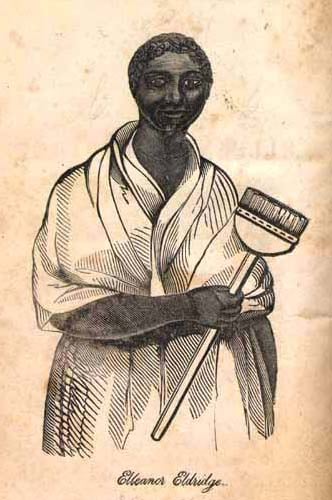
ELLEANOR ELDRIDGE:  Published by Black Wallstreet USA, Feb., 2023

Elleanor Eldridge was born on March 26 1785. She was from Warwick, RI, the youngest of seven daughters and two sons born to Hannah and Robin Eldridge. Her father and two uncles, Africans brought to Rhode Island on a slave ship, earned their freedom by fighting in the American Revolutionary War.

They had been promised 200 acres of land in New York. Instead, they were given a worthless sum.

 Her father was eventually able to save for the purchase of a small parcel of land and build a home in Warwick. Her mother, who was part Indian, died when she was 10. Much to her father's disdain, young Eldridge began washing clothes as a live-in servant for the Baker family of Warwick, one of her mother's former clients.

This young girl, a favorite of  Elleanor Baker, her namesake, made 25 cents a week doing laundry for the family. She also became skilled at spinning, arithmetic and weaving and became an accomplished weaver by age 14.

Three years later, Eldridge began working as a dairy woman for the family of Capt. Benjamin Greene. She quickly became well-known for her premium quality cheeses. When Eldridge was 19, her father died and she put her skills and savvy to use settling his estate. She continued to work for Capt. Greene for five more years until his death. Eldridge then went to live with her sister in Adams, Mass. While there, she and her brothers and sisters started a business of weaving, washing and soap boiling.

Money from that venture enabled Eldridge to buy land and build a house, which she rented for $40 per year.

After three years, she returned to Providence, where she contracted herself out for whitewashing, wallpapering and painting during warm months and laundering and miscellaneous work for private families, hotels and boarding houses during the winters. By 1822, she had saved enough to purchase another lot and built, for $1,700, a house for herself and a renter.

While Eldridge did not marry, she made her mark in the community as an entrepreneurial force; her work was highly praised and she was much respected. Within five years, she bought two more lots and a house in Warwick.

In 1831 at the age of 46 Eldridge suffered from her second bout with typhus fever. While recuperating Eldridge's condition, a rumor circulated that she had died. Upon her return several months later, Eldridge discovered that a deceitful opportunist had petitioned to have all her property sold, to pay off a $240 loan she had acquired just before her illness.

The sale never combined her properties which were valued at more than $4,000 and were illegally auctioned off without family notification. She was able to claim rights to the property and Eldridge took her case to court to expose the law officials who lied about the process. Outraged friends charged that such theft would have never happened to a white man and certainly not a white woman.

During this time despite her own troubles, Eldridge did not abandon her desire for care giving. During a Providence cholera epidemic in 1832, many families escaped to rural areas in seeking safety. Eldridge escorted a family to Pomfret, Conn., where she cared for their sick child. In 1837, she represented herself in court and was able to regain her property for $2,700, in an out-of-court settlement.

Eldridge wrote “Memoirs of Elleanor Eldridge” in 1838; the book is one of few narratives of free Blacks in the 1800’s. It is believed that Eldridge died in 1865 at the age of 80.

For more stories of remarkable women,

see HERSTORY on womensvoicesmedia.org


Leave a comment
  • 1
  • ...
  • 53
  • 54
  • 55
  • ...
  • 56
  • ...
  • 57
  • 58
  • 59
  • ...
  • 60
  • ...
  • 61
  • 62
  • 63
  • ...
  • 167

Women's Voices Media

Women's thought, women's opinions, women's facts presented in a feminist point of view. We endorse works that present in an empirical and logical style.

Search

Categories

Women's Voices Media

  • Editor Byline
  • Home Page
  • Intro
  • Newsworthy

Your Voice

  • Background
  • ERA and CEDAW
  • Economic Justice
  • Education
  • Elections
  • Environment
  • Equal Representation
  • Health and Safety
  • Intersectional Issues
  • Intersectional Issues
  • Intro
  • Judicial System
  • My Voice
  • Politics & Elections
  • Reproductive Rights
  • Social Justice
  • Tech
  • Violence

HerStory

  • Background
  • Intersectional Issues
  • Social Justice
  • Women In Education
  • Women In Politics
  • Women In Science, Technology, & Math (STEM)
  • Women In Sports
  • Women In the Arts
  • Women In the Law
  • Women Not Categorized
  • Women in Business
  • Women's Health & Reproductive Rights
  • Womens Rights

Your Multimedia

  • Art
  • Background
  • Events
  • Intersectional Issues
  • Just Interesting
  • News
  • People
  • Welcome

Women's Resource Library

  • Current News
  • Diverse / Uncategorized
  • ERA and CEDAW
    • CEDAW
    • ERA
  • Environment
    • Air / Atmospheric Polution
    • Alternate Power Sources
    • Climate Change
    • Destruction of Forests and Habitats
    • Sustainability
    • Water Resources
      • Fracking
      • Waste Disposal
  • Equal Representation
    • In Business and Corporations
    • In Education (K-20)
    • In Government
    • In Law Enforcement
    • In Sports
    • In the Justice System
    • Science, Technology, Engineering, and Math (STEM)
  • Equality and Justice
    • Ableism
    • Ageism
    • Child Care
    • Economic Equality
    • Homelessness
    • LGBTQA Discrimination
    • Poverty and Hunger
    • Racism
    • Sexism
  • Gender Studies
  • General Science
  • Girls & Young Women
  • Health and Safety
    • HIV / AIDS
    • Health Insurance
    • Maternal and Infant Care
    • Medical Research
    • Paid Sick and Parental Leave
    • Pregnancy Accommodations
    • Sex Transmitted Diseases
    • Substance Addiction and Abuse
      • Opioid Crisis
      • Physician Over-prescription
  • Herstory
  • Independant Media
  • Politics
  • Reproductive Rights
    • Abortion Rights
      • Roe v. Wade
    • Contraception
  • The Arts
  • Violence
    • Ableism
    • Child Abuse
    • Date Rape
    • Domestic Violence
    • Elder Abuse
    • Genital Mutilation
    • Gun Safety and Control
    • Harrassment
    • LGBTQA - Abuse and Assault
    • Racism
    • Rape / Assault
    • Sex Trafficking / Sex Slavery
    • Women In Prison
  • World Issues

XML Feeds

  • RSS 2.0: Posts
  • Atom: Posts
What is RSS?

Women's Voices Media
This collection 2026 by Janice Jochum
Copyright 2019 United Activision Media, LLC
This work is licensed under a Creative Commons Attribution-NonCommercial 4.0 International License.
• Contact • Help • Multiple blogs done right!

Multiblog engine
Cookies are required to enable core site functionality.