https://www.pewresearch.org/
Pew Research Center is a nonpartisan fact tank that informs the public about the issues, attitudes and trends shaping the world. We conduct public opinion polling, demographic research, content analysis and other data-driven social science research. We do not take policy positions.

Read The U.S. Constitution - Now
Recent polls show just how confused Americans are about our system of government in general and the judiciary in particular. The founders would have found this deeply troubling, as they argued that the people must be “well-informed” and “well-instructed” to be trusted with self-government and to remain free.
A recent poll from the Annenberg Public Policy Center, for example, showed that just 49% say that Supreme Court justices set aside personal and political views to rule based on the law and the facts of each case. At the same time, 48% say that the Supreme Court should be made less independent so that it “listens a lot more to what the people want.”
In a Quinnipiac University poll earlier this year, 59% said that Supreme Court justices are “too influenced by politics.” And in the Annenberg poll, 89% say that judges should base their decisions on “the facts of the case, the law, and the Constitution.” But a recent poll by Marquette University Law School found a majority want judges to treat the Constitution as “a document whose meaning may have evolved over time.”
In the Marquette poll, 37% said senators would be justified in voting against a Supreme Court nominee because of “how they believe the Justice would decide cases.” But a Gallup poll just one year earlier had a different finding: 49% said senators would be justified opposing a nominee because of “the nominee’s stance on current issues such as abortion, gun control or affirmative action.”
All of this puts polls that ask whether people have “trust or confidence” in the Supreme Court or approve of how the Supreme Court is “handling its job” into context. It’s clear that most Americans don’t know what that job is.
But should we be surprised? The Marquette poll showed that 57% of Americans haven’t read the Constitution, even though it’s one of the shortest in the world. In fact, I took two courses in constitutional law in law school and was never required to read it.
Yet, I did read it and so should everyone else. Simply reading the Constitution will reveal a few things. First, to state the obvious, it’s written down. That simplifies the task of trying to figure out what the authors meant.
Second, people will find that some things they thought were in the Constitution aren’t there after all. I don’t mean just the weird things such as thinking the First Amendment protects the right to own a pet (12% think this), as well as seriously misguided things such as the First Amendment supposedly creating a “wall of separation between church and state.” It never actually says that.
People might just see the Constitution is not so mysterious after all. Yes, it was written a long time ago and has some words that have dropped out of popular usage. And yes, there are general-sounding phrases that, at least standing alone, aren’t very clear. But there are also words, phrases, and provisions that have a commonsense meaning. You won’t know until you read it.
The Pew Research Center has found that, as they get older, people shift from saying that the Constitution should be interpreted for what it “means in current times” to what it “meant as originally written.” With a little experience, a little maturity, and a little observation about how easily the tides of political and social life can shift, people seek firmer ground. That’s what makes for successful self-government.
But that can’t happen unless we read it first.
The Heritage Foundation
______________________________________________________________________________________________________________
Thomas Jipping
Deputy Director, Center for Legal and Judicial Studies
Thomas is the Deputy Director of the Edwin Meese III Center for Legal and Judicial Studies and a Senior Legal Fellow.
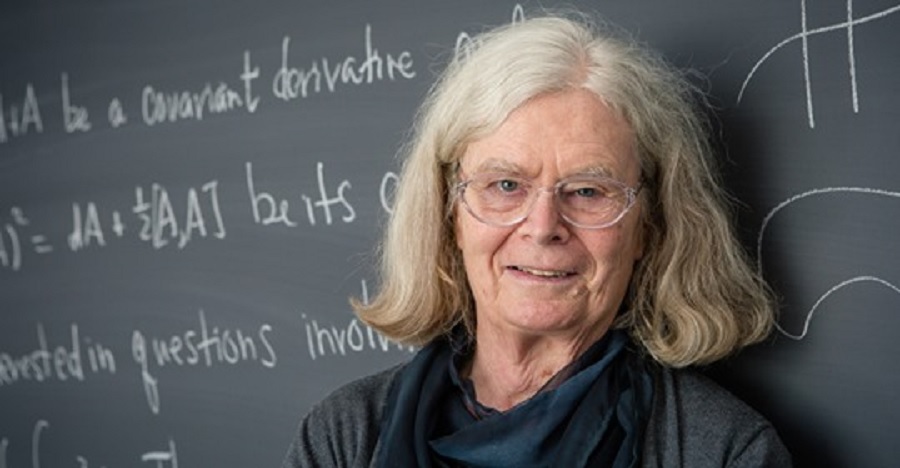
Greetings with some good news for the women’s world. Just recently, one of the most prestigious mathematics prizes in the world – The Abel Prize was awarded to a woman for the first time ever. Yes! Karen Uhlenbeck is a mathematician and a professor at the University of Texas and is now the first woman to win this prize in mathematics. You go Karen!
The award, which is modeled by the Nobel Prize, is awarded by the king of Norway to honor mathematicians who have made an influence in their field including a cash prize of around $700,000. The award to Karen cites for “the fundamental impact of her work on analysis, geometry and mathematical physics.” This award exists since 2003 but has only been won by men since.
Among her colleagues, Dr. Uhlenbeck is renowned for her work in geometric partial differential equations as well as integrable systems and gauge theory. One of her most famous contributions were her theories of predictive mathematics and in pioneering the field of geometric analysis.
Sun-Yung Alice Chang, a mathematician at Princeton University who was in the prize committee says about her: “She did things nobody thought about doing, and after she did, she laid the foundations of a branch of mathematics.”

This month 300 women began the twelfth voyage of an organization called eXXpedition. Leaders from very diverse backgrounds, these women are about to be divided into smaller groups who will each take legs of a 38,000 – nautical – mile trip around the world. This voyage is lengthier than the previous eleven but the purpose is the same: raise awareness of, and explore solutions to, the devastating environmental and health impacts of single-use plastics and toxic pollution in the world’s oceans. If measures are not taken to reverse this pollution, it is estimated that by 2050 the amount of plastic in the ocean will out-weigh fish.
Dr. Lucy Gilliam was working at the U.K.’s Department for Environmental, Food and Rural Affairs (DEFRA) and Emily Penn had spent several years on environmental science missions at sea when they met in 2011 at a panel on oceanic plastic pollution at the Royal Geographic Society in London. They were there because of their concerns about the potential health impact of toxic chemicals in the environment. In 2014 they founded eXXpedition. That same year they set out on their first voyage from Lanzarote, Spain, to Martinique in the Caribbean.
While plastics are an environmental issue, the women say, it is also very much a women’s issues. The plastics are endocrine disruptors. They mimic female hormones. These chemicals have been proven to cause early puberty in girls and to interfere with hormones during pregnancy.
Public awareness and motivation to clean up the problem is their focus but they do conduct scientific studies. They collect water samples to test for plastic and microplastics (any fragments smaller than one-fifth of an inch across), as well as free floating toxic chemicals from detergents, pesticides, pharmaceuticals. They create footage and findings for film and media outreach once the group is back on dry land. And they talk, sharing skills and ideas for how to tackle the problems facing the environment.

Its’ campus consisted of 16 small buildings in Miami Shores, Florida, with a student body of 1,750 when she became the president in 1981. By the time she retired in 2004, Barry University had become a 55-building multi-campus with 7,000 students and included a law school. That was the result of the phenomenal fundraising skills and academic vision of Sister Jeanne O’Laughlin, an Adrian Dominican Sister.
On May 4, 1929, just before the crash of the stock market, Jeanne Marie O’Laughlin was born to Mary Margaret and Thomas O’Laughlin in Detroit, Michigan. While still a child, she would learn what doctors had told her mother on the occasion of Jeanne’s birth. Mary Margaret would never survive another pregnancy.The doctors were right. Five years later Sister O’Laughlin and her three siblings lost their mother when she once again conceived. This memory and that of growing up without a mother would affect some of the views that sometimes caused her to be called into question by the Church.
A streetcar ride when she was thirteen years old would leave another vivid memory that would shape her life. A black woman boarded the car with four small children. As the streetcar lurched forward, one of the children fell into Jeanne’s lap. Jeanne gladly held the child for the remainder of the ride. Later, a man exiting the car spit on Jeanne. That evening when telling her father of the incident, she asked him, “Dad, what causes prejudice?” “Ignorance,” he said. “How do you get rid of it,” she asked. He looked at her and said, “ Only through education”. She knew then what she would do with her life.
In 1958 she earned her bachelor’s degree in mathematics and biology at Siena Heights University. Then earned her masters and doctorate at the University of Arizona. She joined the board at Barry in 1973 while still assistant dean at St. Louis University; assuming the role of Barry’s president in 1981.
Sister Jeanne was dedicated to providing higher education and worked for greater access for all students. To that end she also served as chair of the Council of Independent Colleges; chair of the Association of Catholic Colleges and Universities; president of the Florida Association of Colleges and Universities; and chair of the Independent Colleges and Universities of Florida.
Her involvement in the community went well beyond Barry University. Sister Jeanne held leadership roles in the Greater Miami Chamber of Commerce and the Miami Coalition for a Drug-Free Community. She was the first woman to serve on the Orange Bowl Committee and the first woman to win the Chamber of Commerce’s Sand in My Shoes Award. She was deeply involved on behalf of the homeless and immigrant rights. As the first woman in the Non-Group, an influential behind-the-scenes group of community business men and civic leaders, she helped raise $7 million in private contributions for a fund to help small, black-owned businesses in riot-scarred Liberty City. After the devastation caused by Hurricane Andrew, she was a key figure in We Will Rebuild, the volunteer recovery committee.
After her retirement Sister Jeanne returned to Michigan to the Motherhouse of the Adrian Dominican Sisters. Despite the fact she was battling recurrent cancer, she did not stop her service to others. She helped start the Share the Warmth Center for the homeless and acted as advisor to the Adrian Sisters for their fundraising.
She was 90 when she passed away at the Motherhouse of the Adrian Dominican Sisters.