

If you believe our U.S. Constitution gives women equal rights, you are not alone. When polled about this question, many people reply they believe women have this constitutional right. THIS IS NOT TRUE. The Constitution in actuality was written by and for white men only.
Since women earned the right to vote in 1923, repeated attempts have been made to pass an Equal Rights Amendment (ERA) to the Constitution without success. The most recent attempt passed both chambers of Congress in 1973 with the provision that ratification by 38 or more states must take place by 1979. The deadline was extended to 1982 when less than 38 states had ratified.
In recent years a major push for ratification resulted in Nevada doing so in 2017, followed by Illinois in 2018, and finally Virginia became the 38th state in 2020. Under a 1984 law, the Archivist of the United States is charged with issuing a formal certification after three-fourths of the states ratify. However, on January 8, 2021, the Justice Department’s Office of Legal Counsel issued an opinion that the deadline set by Congress is binding and the ERA has not been ratified. The Archivist refused to issue the certification.
The states of Nevada, Illinois, and Virginia filed suit in Federal District Court arguing that Congress had no power to set a time limit. March 5, 2021, Judge Contreras ruled in favor of enforcing the time limit set by Congress when the amendment was passed.
The struggle for women’s equality has gone on for almost 100 years. Now is the time to establish our equal rights in the Constitution. Now is the time for you to join the fight! Encourage everyone you know to help in the fight. Polls show, when people understand women don’t have equal rights, 94% of them support an amendment enshrining gender equality into the Constitution.
**U.S. Senators Ben Cardin (D-Md.) and Lisa Murkowski (R-Alaska) announced Thursday that the first bipartisan legislation they will introduce for the 117th Congress is their joint resolution to remove the deadline to ratify the Equal Rights Amendment -- S.J.Res.1. Ratification of the ERA would expressly prohibit discrimination on the basis of sex in the U.S. Constitution. In the House of Representatives, the resolution is being introduced by Congresswoman Jackie Speier (D-Calif.) and Congressman Tom Reed (R-N.Y.).**
You need to determine if your members of Congress support this legislation or not. If not, why not? Put their telephone numbers on speed dial so you can call repeatedly, if necessary, until they are committed to voting “YES”. Just go to senate.gov and/or house.gov to find those numbers. Remind them there is no limit on equality.
**Time is up. Let’s get this done**.

By
Alexandria Ocasio-Cortez stood up and gave one of the finest speeches recently heard on the House floor, calling out not just Florida representative Ted Yoho for having called her “disgusting,” “out of your freaking mind,” and a “fucking bitch” on the steps of the Capitol in front of reporters on Tuesday, but also elucidating how that kind of language is normalized and deployed against all kinds of women, on all kinds of days.
It was a remarkable piece of oratory, clear and thoughtful about some of the knottiest dynamics of gendered power imbalance in political, public, and personal life.
After Yoho’s outburst was reported in the Hill, he had offered up a floor speech purported to be apology, though it was actually far closer to pallid self-justification. “Having been married for 45 years with two daughters, I’m very cognizant of my language,” Yoho had said, in a speech in which he did not mention Ocasio-Cortez’s name, and in which he nonsensically refused to “apologize for my passion, or for loving my God, my family, and my country.”
It was this non-apology and not his original outburst, Ocasio-Cortez said on Thursday, that led her to make her own speech, in which she eviscerated Yoho’s use of familial pablum and domestic association with women as evidence of his respect for them. Ocasio-Cortez pointed out that she, too, was someone’s daughter, and that that did not in any way insulate her or other women, also daughters and wives, from the impact of degrading and sexist diminution.
“You can have daughters and accost women without remorse,” Ocasio-Cortez said. “You can … project an image to the world of being a family man and accost women without remorse and with a sense of impunity. It happens every day in this country.”
The electric speech gave ringing voice to the experiences, frustrations, and anger of millions of women and men who have had their days, lives, and realities shaped by often abusive, sometimes vulgar expressions of patriarchal power. Among Ocasio-Cortez’s talents as a politician is her ability to connect and communicate clearly, intellectually, and emotionally, with masses of people; the speech she gave on Thursday put those talents on full display, and she was widely praised for it. New Yorker editor-in-chief David Remnick wrote a column suggesting that Ocasio-Cortez possesses the “rhetorical dynamism” long absent from the House of Representatives and praised her defense of decency, “principle and countless women,” while former DNC head Howard Dean tweeted, “I am now convinced that AOC has what it takes to run for president and to be President.”
But some of the coverage of the impact and resonance of Ocasio-Cortez’s speech perpetuated exactly the gendered power imbalances the speech was meant to challenge. The conflict started by Yoho, to which Ocasio-Cortez was responding, got retold, in the New York Times, as an instance of her aggressive political ambition, rather than as a response to the very forces that have long made political power elusive for women like Ocasio-Cortez, and an assumed norm for men like Ted Yoho.
The Times’ story on the speech bore the headline “A.O.C. Unleashes a Viral Condemnation of Sexism in Congress” and kicked off by noting that Ocasio-Cortez, the youngest woman in Congress, who arrived there in 2019, “has upended traditions.” It called her speech on Thursday “norm-shattering” and described supporting speeches made by her colleagues — including one in which Pramila Jayapal recalled being referred to as a “young lady” who did not “know a damn thing” by Alaska representative Don Young — as a moment of “cultural upheaval.”
All these words somehow cast Ocasio-Cortez and her female colleagues as the disruptive and chaotic forces unleashed in this scenario, suggesting that they shattered norms in a way that Representative Yoho’s original, profane outburst apparently did not. (Perhaps Yoho’s words weren’t understood as eruptive and norm-shattering because calling women nasty names, in your head or with your friends or on the steps of your workplace, is much more of a norm than most want to acknowledge).
As Mark Harris pointed out on Twitter, the Times only printed the full epithet in a piece about Ocasio-Cortez reading it into the House record, after declining to print the words in an earlier story, when they would have been attributed to Yoho. This offered the faint impression that the only person who actually said the actual words “fucking bitch” was AOC herself, and not the man who aimed them at her. What’s more, the paper described her as “punching each syllable in the vulgarity,” reinforcing a view of Ocasio-Cortez’s utterances as pugilistic, without acknowledgment that while she enunciated clearly, she delivered her speech in the calmest and most genial tones imaginable. (An earlier Times story on Yoho’s non-apology and Ocasio-Cortez’s initial response to it described her as having “upbraided” him, and opened with a description of how she “forcefully rejected” his apology.)
Times reporters wrote that Ocasio-Cortez “excels at using her detractors to amplify her own political brand” (Ocasio-Cortez’s “brand” is the subject of frequent coverage; it’s rare that powerful white men are understood as having built brands; they just have careers). The Times described how, in the wake of Yoho’s words, “the media-savvy Ms. Ocasio-Cortez had sprung into action to create disruptive and viral events.” It may seem innocuous to call her “media-savvy” but that too turns a strength — media fluency and, with it, communicative acuity — into a diminishment and obscures the fact that Ocasio-Cortez had not created the disruption in the first place.
In describing her team’s decisions about how to respond, the Times put scare quotes around their plans “to discuss how she ‘was accosted and publicly ridiculed,’” rather than simply reporting that she had been … accosted and publicly ridiculed. The whole thing suggests that she had somehow connived to set this all in motion; that her actions were the active and self-serving ones, while Yoho was a passive actor, his only contribution to the situation providing the platform from which she might spring. As the Times put it: “Republicans have long labored to cast Ms. Ocasio-Cortez as an avatar of the evils of the Democratic Party, a move that Ms. Ocasio-Cortez has used to bolster her own cheeky, suffer-no-fools reputation.”
There is no acknowledgement here that Ted Yoho, not lacking political and professional ambition himself, was also building his brand by deciding to accost Ocasio-Cortez in front of reporters. Nor is there acknowledgment that it worked for him. The percentage of Americans who had ever heard of “Ted Yoho” has risen exponentially in the past 48 hours, and his name will now resonate heroically for a broad swath of AOC/woman-hating Americans.
What is also true and unsaid here is the way in which degradation and dismissal of women — as disgusting, as crazy, but also as Jayapal’s examples remind us, as infantile, incompetent, irrational, and stupid — has been key to the building and maintenance of disproportionately male power in American political, economic, social, and sexual life. And that’s before we get to the ways in which the ubiquity of dehumanizing and aggressive language toward women can have very real violent implications, as the recent murder of Judge Esther Salas’s son by anti-feminist Roy Den Hollander, and so much contemporary mass violence, shows all too often.
How else to clear the field except to render your peers incapable, unlikable, unprofessional? Whether or not men are saying it out loud, via street catcalls or in front of political reporters, the reduction of their would-be female peers — their ideological and electoral adversaries and competitors for power — has helped clear away potential impediment to their own professional trajectories. But white male opportunism, whether in the form of aggressive insult displayed by Yoho this week, or merely accepting the advantages that broad systemic disrespect of others affords them, is rarely examined as the kind of active force that it has always been.
Instead we are trained to recognize the reactions of those who are not white men to white men as some sort of useful path to power. We are told, in lots of ways, that people who are not white men get to play certain kinds of cards — race and gender cards — to get ahead, whereas white men just … get ahead. White male power is so assumed as to be wholly indistinguishable from what we simply recognize as “power,” and with it, the whispered implication that those with authority have somehow earned that authority fairly and squarely, while those who challenge authority and its abuses are wily manipulators. This rankles particularly here, since what Ocasio-Cortez did so well this week was part of her job, the part that is about representing people and their experiences, and communicating effectively on behalf of those who’ve experienced disadvantage. In other words, she actually did earn whatever gains she made this week.
Meanwhile patriarchal power abuse remains so expected as to not be notable as a violation of norms or civility, as disruptive or chaotic. Instead, it simply coexists with the authority, the command, the humanity of white men — it’s just part of what their power looks like.
Consider how Yoho himself explained his derision of Ocasio-Cortez in his House floor speech as an expression of his “passion,” as somehow synonymous with his faith in God and his love for his family. And that Ocasio-Cortez’s senior colleague in her party, Representative Steny Hoyer, immediately responded to Yoho’s speech by calling his words “appropriate,” because “the language we use matters.”
It does matter. The language used about Ocasio-Cortez matters a lot, and will continue to matter as she rises through American politics.
As we read commentators tell the story of women’s ambition and savvy and drive, all of which are surely politically animating forces — as they have been for all the many men who have preceded them in American politics — I hope people can remember that the analysis is not wrong, exactly, but that it is woefully incomplete. Because until we can see how white men have taken advantage of sexism and racism for their own gain — how they’ve built their own “brand,” the American brand — on the backs of the fucking bitches forever, we’re not really reading a full story.
Retrieved from: The Cut
3 March 2021
https://www.thecut.com/2020/07/aoc-speech-ted-yoho-new-york-times.html?utm_source=fb&fbclid=IwAR0KuS4mYJCPKLsn_ROzVuMgLZUVQZIeZwaMJvK2tSBsq2puJkjZNNJAU14
* In response to the Georgia House’s passing of HB 531, an extreme, discriminatory voter suppression bill which includes restrictions on mail-in and weekend voting, strict voter ID requirements, and other measures that disproportionately impact Black voters, voters of color, and rural voters, Monica Simpson, executive director: *
“We are outraged by the passing of HB 531, but are unfortunately not surprised. Whether it’s our voting rights or our reproductive rights, our communities are constantly under attack by elected officials who are determined to use our bodies and wombs as pawns in their conservative political agenda. It’s no surprise that Republican lawmakers are making every effort possible to suppress votes and undermine the extraordinary political power of Georgia’s Black communities and communities of color.
We know whose votes turned our state blue, and within the last few months of 2020, we saw Black women, Southern organizers, and communities of color deliver win after win, from the election of Raphael Warnock, a radical, pro-choice senator from the Deep South, to the elections of President Joe Biden and Vice President Kamala Harris. Our power is tremendous and transformative.
Our right to vote is also imperative to bringing us closer to a world that revolves around love, autonomy, respect and the values of reproductive justice that mean that all people—especially women and communities of color—are able to live healthy, safe and self-determined lives, whether that means having children and families, choosing not to have children or families, or raising the families we have in communities that are free from the the threat of harm or violence.
When our votes are compromised, so is our access to safe and accessible sexual and reproductive health care, which unapologetically includes abortions; when our votes our suppressed, so is our ability to take care of our families and raise our children in sustainable, thriving communities.
HB 531 restricts dropbox access, adds new ID requirements for mail voting, and restricts weekend voting, among other provisions, all of which demonstrate just how unrelenting the GOP-led Georgia legislature is in their attacks on the voting rights of Black voters, voters of color, and rural voters.
Another bill under consideration, SB 241, would also end no-excuse mail voting, implement new ID requirements, and add witness requirements for mail voters- in essence, creating one of the most restrictive absentee voting laws in the entire country and resulting in some of the worst voter suppression since Jim Crow."
* Danielle Rodriguez, Georgia State Coordinator for SisterSong: "In 2020, we saw what it meant when Black women got together and mobilized an entire state to vote. We saw church leaders continue to mobilize members of their congregation to weekend voting caravans for “Souls to the Polls”. We saw our LGBTQIA leaders mobilize together with “Vote with Pride” & “Queer the Vote” And we can’t forget the creativity that came out of Georgia from our night club dancers’ with “Get Your Booty to the Poll”!
*
In the midst of losing our loved ones to the pandemic, police brutality, and police violence, Georgia’s community did amazing work encouraging us all to vote. Unfortunately, the voter suppression bills that have made their way to Georgia’s Capitol are an attack on our Black pride! We did the unthinkable here, and instead of seeing our humanity and the beauty of Black excellence, we are being targeted in an act of hatred and white supremacy.
With little to no time to celebrate our win, we are forced to fight white supremacy, yet again. If you live in Georgia, please follow the work at Fair Fight and participate in their calls to action. Those of you who don’t we invite you to speak up and speak out against this latest atrocity, but to also make a commitment to dismantle and rebuild every system that causes harm to our bodies, our families, and our communities.”
We will continue to keep you updated and to speak out for the health, rights and autonomy of Black, Indigenous and other women of color.
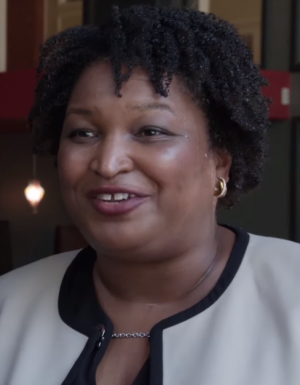
The name Stacey Abrams has become synonymous with voting accessibility and turnout, making history by becoming the first woman and first African American woman to hold positions in state and national politics. Abrams is now one of the most prominent African American female politicians in the United States.
Stacey Yvonne Abrams was born on December 9, 1973 in Madison, Wisconsin. Her mother, Carolyn, was a college librarian and her father, Robert, was a shipyard worker. Coming of age amidst the boycotts and marches of the civil rights movement, both of her parents participated. Her mother was kicked off buses when she tried to sit up front and her father was beaten and jailed for his participation. Carolyn and Robert raised their six kids with a “you-can-be-anything mantra” and advocated civic engagement. Family outings to the polls and outreach trips to prisons were frequent.
The family did not stay long in Wisconsin—Abrams only remembers “the cold and the cheese curds”—and moved to Gulfport, Mississippi. Abrams spent most of her childhood in Gulfport, recalling that her family was part of what her mother called “the genteel poor.” Abrams said this meant the family “had no money, but we watched PBS and read books.” Abrams read the encyclopedia for fun.
Education was of the upmost importance in the Abrams household. Abrams likes to say that her “parents said you could miss school if you had a doctor’s note and a surgical scar.” Abrams credits the public school system with “saving” her and her siblings. Her siblings include a professor of anthropology, federal judge, evolutionary biologist, and a social worker, and the family remains close and the siblings have a book club that meets regularly via conference call.
When Abrams was in high school, the family moved to Atlanta so her parents could attend the Theological Seminary at Emory University. Both became ordained Methodist ministers. In 1991, she was chosen as valedictorian of her high school. Invited to the annual valedictorians’ reception, Abrams and her parents traveled by bus to the governor’s mansion. At the gate, they were told to leave by the guard on duty. While the mistake was eventually corrected, the experience stuck with Abrams. While she knew she belonged, she recalls about that day, “I don’t remember meeting the governor of Georgia or my fellow valedictorians...All I remember that day was a man at a gate, telling me I don’t belong.” She would never let someone make her feel out of place again.
After graduation, Abrams matriculated to Spelman College, an all-women's HBCU in Atlanta. During her freshman year, in 1992, she led a protest against the Rodney King verdict and co-founded a group called the Students for African American Empowerment. She also attended a protest on the steps of the Georgia State Capital where they burned the state flag—which at the time was dominated by the Confederate battle flag. Abrams maintains Confederate symbols should not be in public places of honor. The Georgia state flag was changed in 2003, but Stone Mountain—the largest Confederate monument in the world—still stands just outside of Atlanta. Abrams has called for its removal.
She graduated from Spelman “magna cum laude” with a B.A. in interdisciplinary studies (political science, economics, and sociology) and was named a Harry S. Truman Scholar; the scholarship is awarded to a few public-service oriented students every year. Abrams’s education did not stop with her B.A. She received a Master’s Degree from the Lyndon B. Johnson School of Public Affairs at the University of Texas at Austin, and a J.D. from Yale University. Abrams then returned to Atlanta as a tax attorney. At 29 she was appointed the Deputy City Attorney for Atlanta. She also co-founded a number of businesses, including a financial-services firm in Atlanta.
In 2006, Abrams was elected to the Georgia House and quickly gained a reputation for bipartisanship. In 2010, she became the House Minority leader—the first African American woman to do so in Georgia. Abrams advocated to increase educational opportunity and promote economic security. Inspired by her brother’s experience with mental illness and addiction, she has also called for criminal justice reform, expanded Medicaid, and a better understanding of mental illness. In 2013, while still a member of the Georgia House, she created a voter registration non-profit called The New Georgia Project. It helped complete 86,000 new voter applications, many of whom came from voters of color.
Abrams rose to national prominence when she ran for governor of Georgia in 2018. While she lost that race by about 55,000 votes, her candidacy was historic in and of itself. When she won the Democratic primary in that race, she became the first African American woman to receive a major party’s nomination for governor. During her campaign, she focused on bringing new voters to the polls—an extension of the work she did with the New Georgia Project. The race was also historic for other reasons; there were a series of allegations of voter suppression, particularly those targeted at suppressing the votes of African Americans. Abrams recalled after losing, “I sat shiva for 10 days. Then I started plotting.” She would not let voter suppression or lack of turnout affect the outcome of another race again.
Abrams continues to advocate for and help with voter registration and founded Fair Fight Action in 2018. Fair Fight is an organization created to address the issues of voter suppression. Abrams is credited with being one of the major forces behind Democrats’ wins in Georgia in the 2020 Presidential and Senate races.
Abrams continues to serve as the face of voting advocacy around the country. She has started and inspired many organizations that work to register and turn out voters, particularly young voters and voters of color. For her work, Abrams has received numerous awards including: the John F. Kennedy New Frontier Award (2012), Friend of Labor Award from the Georgia AFL-CIO, and others in recognition for her work as a public servant. In February 2021, she was nominated for the Nobel Peace Prize. Abrams also serves on numerous boards for educational and non-profit organizations.
Abrams is also an author. She has written two non-fiction books: Minority Leader: How to Lead from the Outside and Make Real Change (2018) and Our Time Is Now: Power, Purpose, and the Fight for a Fair America (2020).
MLA – Rothberg, Emma. “Stacey Abrams.” National Women’s History Museum, 2021. 2 March 2021.
Chicago – Rothberg, Emma. “Stacey Abrams.” National Women’s History Museum. 2021.