Meet Margaret Hamilton
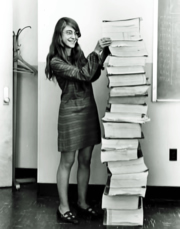
The badass '60s programmer who saved the moon landing
Her code fixed a malfunction that could’ve prevented Buzz Aldrin and Neil Armstrong from landing safely.
July 19 will mark the 50th anniversary of Apollo 11's arrival on the moon. The lunar lander holding Neil Armstrong and Buzz Aldrin touched down at 4:18 pm Eastern time, and Armstrong became the first human in history to walk on the lunar surface at 10:56 pm.
Huge amounts of aeronautical and hardware engineering effort went into the Apollo program from its birth in 1961 to its completion in 1972, as NASA and its partners designed the Saturn V rocket to get astronauts out of Earth's orbit, the command/service modules that orbited the moon, and the lunar modules that actually landed on the moon. But Apollo was also a major software project. Astronauts used the Apollo Guidance Computer, which was placed in both the command module and the lunar module, for navigation assistance and to control the spacecraft, and someone needed to program it.
The software for the guidance computer was written by a team at the MIT Instrumentation Laboratory (now the Draper Laboratory), headed up by Margaret Hamilton. Above is an amazing picture of her next to the code she and her colleagues wrote for the Apollo 11 guidance computer that made the moon landing possible.
How good software saved Apollo 11
Hamilton's code was good — so good, in fact, that it very well might have saved the entire Apollo 11 mission. The rendezvous radar (the radar system to be used when leaving the moon and reconnecting with the control module) and the computer-aided guidance system in the lunar module used incompatible power supplies. The radar, which didn't really have a purpose in the landing portion of the mission, started sending the computer lots and lots of data based on random electrical noise, just as Buzz Aldrin and Neil Armstrong were attempting to land. This overloaded the computer and threatened to leave no room for the computational tasks necessary for landing.