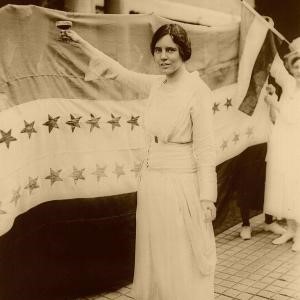
This article was first published as "Three United States Feminists--A Personal Tribute," Jewish Affairs 53.1 (Johannesburg, South Africa, 1998): 37.
Alice Stokes Paul (END NOTE 1), characterized as "probably the only charismatic figure generated by the feminist movement in its salad days," (END NOTE 2) was born on January 11, 1885, on a 214-acre farm in Moorestown, New Jersey, a few miles from Philadelphia.
Her education was prodigious and remarkable for a woman in the early years of this century. She started with a BA degree from Swarthmore in 1905 and later graduated from what is today the Columbia University School of Social Work. Then she earned a Master's degree at the University of Pennsylvania; studied in England at the Woodbrooke Settlement for Religious and Social Study outside Birmingham, the University of Birmingham, and the School of Economics; and received a PhD at the University of Pennsylvania. Finally, she got an LLB from the Washington College of Law in 1922, an LLM from American University in 1927, and a Doctor of Civil Law degree from American University in 1928.
While she was pursuing these studies, she was also doing social work in the US and England and championing the cause of woman's suffrage. In England in 1909, she joined the ranks of the founder of the British suffrage movement, Emmeline Pankhurst, and her daughters Sylvia and Christabel. In the United Kingdom, Alice Paul was imprisoned three times, and when she went on hunger strikes to pressure the government to grant women suffrage, she was force-fed.
On returning to the US, Miss Paul (her preferred designation) recognized the need for a constitutional amendment to secure votes for women. Such an amendment had been drafted in 1875 by Susan B. Anthony, America's famous nineteenth century suffragist, or Elizabeth Cady Stanton (its authorship is unclear). Starting in 1878, it had been introduced in Congress for years. But it had languished, partly because there had not been the necessary lobbying to get it passed and ratified. By the time Miss Paul came on the scene, efforts to secure a federal amendment were all but dead, and the suffrage movement was concentrating on getting the vote on a state-by-state basis.
In late 1912, Miss Paul persuaded the National American Woman Suffrage Association (NAWSA), headquartered in New York City, to appoint her co-chair of its near-defunct Congressional Committee in Washington, DC. She agreed to lobby for passage of a constitutional amendment provided she could raise the money she needed. Serving as co-chair with her was Lucy Burns, an American suffragist she had met in a London police station after they had both been arrested in a suffrage demonstration at the entrance to Parliament. Miss Paul and Miss Burns became chairman and vice-chairman, respectively, of NAWSA's Congressional Committee.
Miss Paul came to Washington in December 1912. At the end of the month, she rented a basement room at 1420 F Street Northwest, which she opened in January as the office of the Congressional Committee. Two months later, she staged a suffrage spectacle unequaled in the political annals of the nation's capital, taking advantage of the festive arrangements and publicity potential surrounding Woodrow Wilson's inauguration. On March 3, 1913, the day before the inauguration, Miss Paul, a master of spectacle and street theater, coordinated a march of some eight thousand college, professional, middle- and working-class women, in costumed marching units, each with its own banners. Leading the parade in flowing white robes, astride a white horse, was a lawyer and suffragist Inez Milholland Boissevain, followed by suffrage floats and marching units going down Pennsylvania Avenue from the Capitol past the White House.
Early on, Miss Paul saw the need for an additional organization. The Congressional Committee had neither the time to raise funds nor the power to recruit members beyond the five Committee members appointed by NAWSA. So in April 1913, Miss Paul and the rest of the Committee formed the Congressional Union for Woman Suffrage. Two years later she and her colleagues formed the Woman's Party for women in the West who had obtained the vote. By the end of 1916, these organizations coalesced into the National Woman's Party (NWP) under Alice Paul's leadership. She called a halt to any further pleading and, instead, mounted a militant political campaign demanding passage of the suffrage amendment, which she named the Susan B. Anthony Amendment. She made suffrage an issue in the elections of 1914 and 1916, sending women to campaign against Democrats, who were in control of the White House and Congress.
NWP used a panoply of tactics to dramatize the suffrage movement and marshall public and political support in its favor. These included parades, demonstrations, mass meetings, picketing, suffrage watch fires, hunger strikes, deputations to the President, communication with the press, publication of a stylish weekly called the Suffragist, organizing women who had secured suffrage in western states, and lobbying. Suffragists released from jail, dressed in prison garb, rode a train called the Prison Special on a speaking tour throughout the country. Others conducted automobile petition drives throughout the West; as they made their way across the country, they stopped in cities and towns along the route and secured the signatures of hundreds of thousands of women and men on suffrage petitions to be delivered to Congress.
NWP implemented the policy Miss Paul had brought with her from England of holding the party in power responsible for the lack of progress in achieving suffrage and of working against that party. During the presidential campaign of 1916, Miss Paul and NWP members campaigned extensively against President Wilson and other Democratic officeholders because of their continuing refusal to actively support the Suffrage Amendment. This was the first time a campaign of that nature had been waged in the history of the United States. In January 1917, the first group of American citizens to dramatize its political protest by picketing the White House appeared. They were suffrage pickets, known as Silent Sentinels, holding banners with political slogans and demanding the right to vote. Although told by the chief of police that picketing the White House was prohibited, the picketers continued, becoming the first group in the United States to wage a nonviolent civil disobedience campaign. In July 1917, the arrests of picketers began. Eventually, hundreds of women were arrested on charges of "obstructing sidewalk traffic." Many, including Alice Paul, were convicted and sentenced to prison at the Occoquan Workhouse (now the Lorton Correctional Complex) in Virginia or the District of Columbia Jail.
The conditions in which the suffragists were held at the Occoquan Workhouse were appalling. Blankets were washed once a year. There were open toilets, which could only be flushed from outside the cell by the guard, who might or might not come when called. Women who were on a hunger strike were force-fed. Doris Stevens, one of the prisoners, wrote in the Suffragist of August 11, 1917:
No woman there will ever forget the shock and the hot resentment that rushed over her when she was told to undress before the entire company... We silenced our impulse to resist this indignity, which grew more poignant as each woman nakedly walked across the great vacant space to the doorless shower... (END NOTE 3)
In a complaint filed by Lucy Burns concerning conditions at the Workhouse, Ms. Burns stated:
The water they [the suffragists] drink is kept in an open pail, from which it is ladled into a drinking cup. The prisoners frequently dip the drinking cup directly into the pail. The same piece of soap is used for every prisoner. As the prisoners in Occoquan are sometimes afflicted with disease, this practice is appallingly negligent.(END NOTE 4)
Virginia Bovee, who had been an officer at the Workhouse, stated in an affidavit given after her discharge:
The beans, hominy, rice, corn meal . . . and cereal have all had worms in them. Sometimes the worms float on top of the soup. Often they are found in the corn bread. (END NOTE 5)
November 15, 1917, was the Night of Terror at Occoquan:
Under orders from W. H. Whittaker, superintendent of the Occoquan Workhouse, as many as forty guards with clubs went on a rampage, brutalizing thirty-three jailed suffragists. They beat Lucy Burns, chained her hands to the cell bars above her head, and left her there for the night. They hurled Dora Lewis into a dark cell, smashed her head against an iron bed, and knocked her out cold. Her cellmate Alice Cosu, who believed Mrs. Lewis to be dead, suffered a heart attack. According to affidavits, other women were grabbed, dragged, beaten, choked, slammed, pinched, twisted, and kicked. (END NOTE 6)
In all, Miss Paul served three prison terms in the US. During her imprisonment in the District of Columbia Jail in October 1917, weakened by her hunger strike, she was taken by stretcher to the prison hospital. There she was held incommunicado: no attorney, no member of her family, no friend was allowed to see her. Prison officials threatened her with transfer to the jail's psychopathic ward and St. Elizabeth's Hospital, the Government's institution for the insane, if she did not break her hunger strike. When she refused, she was taken by stretcher to a cell in the prison's psychopathic ward and treated like a mental patient. At night, she could not sleep for more than a few minutes at a time because an electric light was aimed at her face once every hour all through the night. She lived in dread of being transferred to St. Elizabeth's. After a week in the ward, through the intercession of a supporter, Dudley Field Malone, the well-known lawyer and liberal, she was returned to the jail's hospital. A week later she was released.( END NOTE 7) Undaunted, she fought on.
In May and June 1919, Congress passed the Susan B. Anthony Amendment. Now it was necessary to secure ratification by the legislatures of thirty-six states (three-quarters of the-then forty-eight). Some believed that this would take twenty years, but they did not reckon with Alice Paul. With her leadership of campaigns throughout the country, the thirty-sixth state ratified in August 1920. The Nineteenth Amendment became part of the Constitution of the United States, and in 1920 the women of the United States voted in a presidential election for the first time. It had taken seventy-two years beginning with the first Woman's Rights Convention at Seneca Falls, New York, in July 1848 -- spanning two centuries, eighteen presidencies, and three wars -- for American women to get the right to vote.
In 1920, Miss Paul and NWP commissioned feminist and sculptor Adelaide Johnson to create a statue to present to Congress to commemorate the passage of the Amendment and to celebrate those women whose lives had been devoted to women's suffrage. The statue, which has been referred to as the Pioneer Suffrage Statue, the Suffrage Pioneers, the Portrait Monument, and the Woman Movement (by its sculptor), was made in Carrara, Italy, where the marble was quarried. It represented the past, present, and future of the woman's suffrage movement and depicted the three suffrage pioneers, with Lucretia Mott in front, followed by Elizabeth Cady Stanton and Susan B. Anthony. The unfinished portion in the back of the statue represented the rise of women leaders to come. The statue was placed in the Rotunda of the Capitol on February 15, 1921, Susan B. Anthony's birthday. The reception held for Adelaide Johnson to celebrate this event was the first ever given for a woman in the Capitol building. The statue remained in the Rotunda for two days, after which it was relegated to the crypt of the Capitol. The statue remains to this day the only national monument to the women's movement.
In 1923, Miss Paul took the second step she had always planned and drafted the Equal Rights Amendment (ERA) to the Constitution, and it was introduced in Congress. The ERA prohibited discrimination based on sex by the federal and state governments. Its purpose was to give women explicit constitutional protection not afforded by the Equal Protection clause of the Fourteenth Amendment.
Miss Paul expanded NWP's activities into the international arena when she organized the International Advisory Committee of NWP in the late 1920s, which led her to found the World Woman's Party (WWP) in 1938. WWP, later renamed the World Woman's Party for Equal Rights, was headquartered in Geneva, Switzerland. During its most active period, from 1938 to 1953, WWP worked in the international political arena, and, in particular, with the League of Nations, to promote equality for women around the world. Among other achievements, it was responsible for the establishment of the United Nations Commission on the Status of Women in 1946.
During the first two years of World War II, which started in Europe on September 1, 1939, Miss Paul assisted Europeans, including feminists, Jews, and their families, who had been forced to leave their own countries because of the Nazi terror. WWP's headquarters, the Villa Bartholoni on the shores of Lake Geneva, became a refuge for these people. WWP and Miss Paul not only offered temporary shelter to these refugees but assisted them in finding American sponsors, securing passports, and getting safe passage to the United States. Owing to problems caused by the restrictions imposed by the Nazis, WWP relocated to Washington, DC, in the spring of 1941 for the remainder of the war.
One of the women Miss Paul helped was another Alice -- Alice Muller. Before the Nazis came to power, Ms. Muller, who was Jewish, lived with her family in Karlsruhe, Germany, where her husband was a professor of Latin, English, and Ancient Greek at the Gymnasium, the secondary school for students preparing to enter a university. In 1936, Professor Muller was dismissed because he was Jewish. On Kristallnacht (the Night of Broken Glass), November 9, 1938, he was arrested by the Gestapo and taken to the Buchenwald Concentration Camp. Through the intercession of a Swiss government official who was a close friend of the family, Professor Muller was released seventeen days after his arrest on condition that he leave Germany by the end of that year. On December 31, 1938, the Muller family moved to Adelboden, a Swiss mountain village.
The autumn of 1939 found the family in Geneva. They had moved there to be closer to the League of Nations, which they hoped would assist them in leaving Switzerland. Due to Alice Muller's interest in women's rights, she met Alice Paul and became a volunteer at WWP. When the Mullers' landlady needed the apartment back, Miss Paul invited them to stay at the Villa Bartholoni at a minimal rent. Also staying there at the time, under similar circumstances, were Professor Doctor Homburger, a world-renowned ophthalmologist who had previously been on the medical faculty of the University of Berlin, and his wife, and Dr. Lowenstein, formerly editor of a newspaper in Vienna, who was subsequently employed by the New York Times, and his wife.
The Mullers later emigrated to the United States and, through the auspices of the Jewish Agricultural Society, by coincidence, were relocated in Atco, New Jersey, the state where Alice Paul was born and raised. In the 1970s, through a newspaper article, Alice Muller learned that Miss Paul was living in reduced circumstances in the Alta Craig Nursing Home in Ridgefield, Connecticut. Ms. Muller's son, James, an attorney in Cherry Hill, New Jersey, suggested to Alexander Wood, a judge of the Superior Court of New Jersey and a Quaker, that the Quakers of Moorestown look into providing assistance to Miss Paul. Through the intercession of those Quakers, Miss Paul was moved to the Greenleaf Extension Home in Moorestown, an institution that had originally been endowed many years earlier with funds from Alice Paul's family. At the Greenleaf home, Miss Paul was visited by the Mullers, the family for whom she had provided shelter in Geneva so many years earlier.
From the mid-1950s on, Miss Paul's focus returned to the status of women in the United States. In the late 1950s, when Congress was considering passage of a civil rights bill, Alice Paul was unsuccessful in arguing for the inclusion of a prohibition against sex discrimination. But she was successful in the '60s. Although Miss Paul was seventy-nine at the time, she ran the lobbying campaign to include the category of sex discrimination in the Civil Rights Act of 1964 from NWP's headquarters in the Sewall-Belmont House on Capitol Hill. She and her lieutenants had close ties to Congressman Howard W. Smith, who introduced the amendment to include sex discrimination in Title VII of that Act, the employment title. NWP later played a critical role when the bill was under consideration in the Senate. It was the only woman's organization that fought for the inclusion of a prohibition against sex discrimination in Title VII.
I first had the privilege of meeting Alice Paul when I was working at the EEOC in Washington, DC. She invited me to dine with her one evening at a memorable candlelight dinner on the patio of the Sewall-Belmont House. Years later, when I was living in Stamford, Connecticut, I learned that she was in the Alta Craig Nursing Home in Ridgefield, Connecticut, and I made an appointment to visit her.
Before I left home, my daughter Zia, who was then four years old, asked me where I was going, and I told her to see Alice Paul. "Who's Alice Paul?" she asked. I told her that when she grew up and was able to vote, it would be because of Alice Paul.
I visited Miss Paul in March of 1976. When I entered her room, she was seated in a chair in a light blue dress that accentuated the blue of her eyes. She had a necklace of beads at her throat and a pink shawl over her legs.
We talked about the women's movement, NWP, the recent dedication of the Alice Paul Women's Center at her alma mater Swarthmore College -- something that gave her great pleasure -- and "Shoulder to Shoulder", the song featured on the Masterpiece Theater series of the same name about the British suffrage movement.
Alice Paul had never married; she devoted her life to women's rights. But when we spoke, she expressed feelings of guilt. She was concerned that she was "useless" now because at the age of ninety-one she wasn't "doing anything" for women.
Alice Paul was not "useless" then and never will be. Although over twenty years have passed since her death in Moorestown, the town of her birth, on July 9, 1977, she remains an inspiration to me and other feminists. I serve on the Board of NWP, which continues to fight for ratification of the ERA and for other women's rights issues. In that capacity, I was present at the rededication ceremony on June 26, 1997, when, after seventy-six years and a Resolution of Congress, and with $75,000 raised privately by the Move the Statue Campaign, a project of the National Museum of Women's History, the statue of the suffrage leaders was returned to its rightful place -- in the Rotunda of the Capitol of the United States.
--------------------------
1. The author is indebted to Amelia Fry, Alice Paul's biographer, for her invaluable assistance.
2. William L. O'Neill, Everyone Was Brave: A History of Feminism in America (Chicago: Quadrangle Books, 1971) 126.
3. Barbara Leaming, Katherine Hepburn (New York: Crown Publishers, 1995), 274-5.
4. Leaming 275-6.
5. Leaming 276.
6. Leaming 182.
7. Doris Stevens, Jailed for Freedom (New York: Liveright Publishing, 1920) 216-223.
Copyright 1998 by Sonia Pressman Fuentes
Note: A biography of Sonia Pressman Fuentes also appears in HerStory.
#womensvoicesmedia