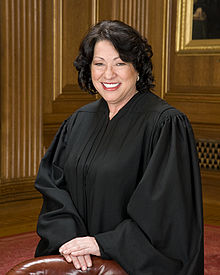
Sonia Maria Sotomayor was born June 25, 1954, in the New York City borough of The Bronx. Her father was Juan Sotomayor (c. 1921-1964) from the area of Santura, San Juan, Puerto Rico, and her mother was Celina Báez (1927-2021) an orphan] from the neighborhood of Santa Rosa in Lajas, a rural area on Puerto Rico's southwest coast. The two left Puerto Rico separately, met, and married during World War II after Celina served in the Women's Army Corps. Juan Sotomayor had a third-grade education, did not speak English, and worked as a tool and die worker; Celina Baez worked as a telephone operator and then a practical nurse. Sonia's younger brother, Juan Sotomayor (born c. 1957), later became a physician and university professor in the Syracuse, New York, area
Sotomayor was raised a Catholic and grew up in Puerto Rican communities in the South Bronx and East Bronx; she self-identifies as a "Nuyorican". The family lived in a South Bronx tenement before moving in 1957 to the well-maintained, racially and ethnically mixed, working-class Bronxdale Houses housing project. Her relatively close proximity to Yankee Stadium led her to becoming a lifelong fan of the New York Yankees. Her extended family got together frequently and she regularly visited Puerto Rico during summers.
Sonia grew up with an alcoholic father and a mother who was emotionally distant; she felt closest to her grandmother, who she later said gave her a source of "protection and purpose". Sonia was diagnosed with type 1 diabetes at age seven and began taking daily insulin injections. Her father died of heart problems at age 42, when she was nine years old. After this, she became fluent in English. Sotomayor has said that she was first inspired by the strong-willed Nancy Drew book character, and then after her diabetes diagnosis led doctors to suggest a different career from detective, she was inspired to go into a legal career and become a judge by watching the Perry Mason television series. She reflected in 1998: "I was going to college and I was going to become an attorney, and I knew that when I was ten. Ten. That's no jest".
Celina Sotomayor put great stress on the value of education; she bought the Encyclopædia Britannica for her children, something unusual in the housing projects. Despite the distance between the two, which became greater after her father's death and which was not fully reconciled until decades later, Sotomayor has credited her mother with being her "life inspiration". For grammar school, Sotomayor attended Blessed Sacrament School in Soundview, where she was valedictorian and had a near-perfect attendance record. Although underage, Sotomayor worked at a local retail store and a hospital. Sotomayor passed the entrance tests for and then attended Cardinal Spellman High School in the Bronx. At Cardinal Spellman, Sotomayor was on the forensics team and was elected to the student government. She graduated as valedictorian in 1972. Meanwhile, the Bronxdale Houses had fallen victim to increasing heroin use, crime, and the emergence of the Black Spades gang. In 1970, the family found refuge by moving to Co-op City in the Northeast Bronx.
Sotomayor entered Princeton University on a full scholarship, by her own later description gaining admission in part due to her achievements in high school and in part because affirmative action made up for her standardized test scores not being fully comparable to those of other applicants. She would later say that there are cultural biases built into such testing and praise affirmative action for fulfilling "its purpose: to create the conditions whereby students from disadvantaged backgrounds could be brought to the starting line of a race many were unaware was even being run."
She would describe her time at Princeton as a life-changing experience. Initially, she felt like "a visitor landing in an alien country as her exposure had been limited to the Bronx and Puerto Rico. Princeton had few women students and fewer Latinos (about 20). She was too intimidated to ask questions during her freshman year; her writing and vocabulary skills were weak, and she lacked knowledge in the classics. She put in long hours in the library and over summers, worked with a professor outside of class, and gained skills, knowledge, and confidence. She became a moderate student activist and co-chair of the Acción Puertorriqueña organization, which served as a social and political hub and sought more opportunities for Puerto Rican students. She worked in the admissions office, traveling to high schools and lobbying on behalf of her best prospects.
As an activist, Sotomayor focused on faculty hiring and curriculum, since Princeton did not have a single full-time Latino professor nor any class on Latin American studies. A meeting with university president William G. Bowen in her sophomore year saw no results, leading to Sotomayor's saying in a New York Times story at the time that "Princeton is following a policy of benign neutrality and is not making substantive efforts to change. So, Acción Puertorriqueña filed a formal letter of complaint in April 1974 with the Department of Health, Education and Welfare, saying the school discriminated in its hiring and admission practices. Sotomayor wrote opinion pieces for the Daily Princetonian with the same theme. The university began to hire Latino faculty, and Sotomayor established an ongoing dialogue with Bowen Sotomayor also successfully persuaded historian Peter Winn to create a seminar on Puerto Rican history and politics. Sotomayor joined the governance board of Princeton's Third World Center and served on the university's student–faculty Discipline Committee, which issued rulings on student infractions. She also ran an after-school program for local children] and volunteered as an interpreter for Latino patients at Trenton Psychiatric Hospital..
Academically, Sotomayor stumbled her first year at Princeton but later received almost all A's in her final two years of college. Sotomayor wrote her senior thesis at Princeton on Luis Muñoz Marín, the first democratically elected governor of Puerto Rico, and on the territory's struggles for economic and political self-determination. The 178-page work, "La Historia Ciclica de Puerto Rico: The Impact of the Life of Luis Muñoz Marin on the Political and Economic History of Puerto Rico, 1930–1975", won honorable mention for the Latin American Studies Thesis Prize. As a senior, Sotomayor won the Pyne Prize, the top award for undergraduates, which reflected both strong grades and extracurricular activities. In 1976, she was elected to Phi Beta Kappa and graduated summa cum laude with an A.B. in history. She was influenced by critical race theory, which would be reflected in her later speeches and writings.
On August 14, 1976, just after graduating from Princeton, Sotomayor married Kevin Edward Noonan, whom she had dated since high school in a small chapel at St. Patrick's Cathedral in New York She used the married name Sonia Sotomayor de Noonan. He became a biologist and a patent lawyer.
Sotomayor entered Yale Law School in the fall of 1976, once more on a scholarship. While she believes she again benefited from affirmative action to compensate for somewhat lower standardized test scores, a former dean of admissions at Yale has said that given her record at Princeton, it probably had little effect. At Yale she fit in well although she found there were again few Latino students. She was known as a hard worker but she was not considered among the star students in her class. Yale General Counsel and professor José A. Cabranes acted as an early mentor to her to successfully transition and work within "the system". She became an editor of the Yale Law Journal and was also managing editor of the student-run Yale Studies in World Public Order publication (later known as the Yale Journal of International Law. Sotomayor published a law review note on the effect of possible Puerto Rican statehood on the island's mineral and ocean rights. She was a semi-finalist in the Barristers Union mock trial competition. She was co-chair of a group for Latin, Asian, and Native American students, and her advocacy to hire more Hispanic faculty was renewed.
Following her second year, she gained a job as a summer associate with the prominent New York law firm Paul, Weiss, Rifkind, Wharton & Garrison. By her own later evaluation, her performance there was lacking. She did not receive an offer for a full-time position, an experience that she later described as a "kick in the teeth" and one that would bother her for years. In her third year, she filed a formal complaint against the established Washington, D.C., law firm of Shaw, Pittman, Potts & Trowbridge for suggesting during a recruiting dinner that she was at Yale only via affirmative action. Sotomayor refused to be interviewed by the firm further and filed her complaint with a faculty–student tribunal, which ruled in her favor. Her action triggered a campus-wide debate, and news of the firm's subsequent December 1978 apology made The Washington Post.
In 1979, Sotomayor was awarded a Juris Doctor from Yale Law School. She was admitted to the New York Bar the following year.
On the recommendation of Cabranes, Sotomayor was hired out of law school as an assistant district attorney under New York County District Attorney Robert Morgenthau starting in 1979. She said at the time that she did so with conflicted emotions: "There was a tremendous amount of pressure from my community, from the third world community, at Yale. They could not understand why I was taking this job. I'm not sure I've ever resolved that problem." In general, she showed a passion for bringing law and order to the streets of New York, displaying special zeal in pursuing child pornography cases, unusual for the time. She worked 15-hour days and gained a reputation for being driven and for her preparedness and fairness. One of her job evaluations labelled her a "potential superstar’. Morgenthau later described her as "smart, hard-working, [and having] a lot of common sense and as a "fearless and effective prosecutor. She stayed a typical length of time in the post and had a common reaction to the job: "After a while, you forget there are decent, law-abiding people in life.
Sotomayor and Noonan divorced amicably in 1983. From 1983 to 1986, Sotomayor had an informal solo practice, dubbed Sotomayor & Associates, located in her Brooklyn apartment. She performed legal consulting work, often for friends or family members.
In 1984, she entered private practice, joining the commercial litigation practice group of Pavia & Harcourt in Manhattan as an associate. One of 30 attorneys in the law firm she specialized in intellectual property litigation, international law, and arbitration. In addition to her law firm work, Sotomayor found visible public service roles. She was not connected to the party bosses that typically picked people for such jobs in New York, and indeed she was registered as an independent. Instead, District Attorney Morgenthau, an influential figure, served as her patron In 1987, Governor of New York Mario Cuomo appointed Sotomayor to the board of the State of New York Mortgage Agency, which she served on until 1992 as part of one of the largest urban rebuilding efforts in American history,
Sotomayor had wanted to become a judge since she was in elementary school, and in 1991 she was recommended for a spot by Democratic New York senator Daniel Patrick Moynihan. Sotomayor was thus nominated on November 27, 1991, by President George H. W. Bush to a seat on the U.S. District Court for the Southern District of New York vacated by John M. Walker Jr. Senate Judiciary Committee hearings, led by a friendly Democratic majority, went smoothly for her in June 1992, getting her unanimous approval of the committee. Then a Republican senator blocked her nomination and that of three others for a while in retaliation for an unrelated block Democrats had put on another nominee. Some weeks later, the block was dropped, and Sotomayor was confirmed by unanimous consent of the full United States Senate on August 11, 1992, and received her commission the next day. She became the youngest judge in the Southern District and the first Hispanic federal judge in New York State. She became the first Puerto Rican woman to serve as a judge in a U.S. federal court. and was one of seven women among the district's 58 judges. She moved from Carroll Gardens, Brooklyn, back to the Bronx in order to live within her district.
Sotomayor generally kept a low public profile as a district court judge. In criminal cases, she gained a reputation for tough sentencing and was not viewed as a pro-defense judge. A Syracuse University study found that in such cases, Sotomayor generally handed out longer sentences than her colleagues, especially when white-collar crime was involved,
On June 25, 1997, Sotomayor was nominated by President Bill Clinton to a seat on the U.S. Court of Appeals for the Second Circuit, which was vacated by J. Daniel Mahoney. Her nomination was initially expected to have smooth sailing, with the American Bar Association Standing Committee on the Federal Judiciary giving her a "well qualified" professional assessment. However, as The New York Times described, "[it became] embroiled in the sometimes tortured judicial politics of the Senate. Some in the Republican majority believed Clinton was eager to name the first Hispanic Supreme Court justice and that an easy confirmation to the appeals court would put Sotomayor in a better position for a possible Supreme Court nomination (despite there being no vacancy at the time nor any indication the Clinton administration was considering nominating her or any Hispanic). Therefore, the Republican majority decided to slow her confirmation. Radio commentator Rush Limbaugh weighed in that Sotomayor was an ultraliberal who was on a "rocket ship" to the highest court.
During her September 1997 hearing before the Senate Judiciary Committee, Sotomayor parried strong questioning from some Republican members about mandatory sentencing, gay rights, and her level of respect for Supreme Court Justice Clarence Thomas. After a long wait, she was approved by the committee in March 1998, with only two dissensions. However, in June 1998, the influential Wall Street Journal editorial page opined that the Clinton administration intended to "get her on to the Second Circuit, then elevate her to the Supreme Court as soon as an opening occurs"; the editorial criticized two of her district court rulings and urged further delay of her confirmation. The Republican block continued.
Ranking Democratic committee member Patrick Leahy objected to Republican use of a secret hold to slow down the Sotomayor nomination, and Leahy attributed that anonymous tactic to GOP reticence about publicly opposing a female Hispanic nominee. The prior month, Leahy had triggered a procedural delay in the confirmation of fellow Second Circuit nominee Chester J. Straub—who, although advanced by Clinton and supported by Senator Moynihan, was considered much more acceptable by Republicans—in an unsuccessful effort to force earlier consideration of the Sotomayor confirmation.
During 1998, several Hispanic organizations organized a petition drive in New York State, generating hundreds of signatures from New Yorkers to try to convince New York Republican senator Al D'Amato to push the Senate leadership to bring Sotomayor's nomination to a vote. D'Amato, a backer of Sotomayor to begin with and additionally concerned about being up for re-election that year helped move Republican leadership. Her nomination had been pending for over a year when Majority Leader Trent Lott scheduled the vote. With complete Democratic support, and support from 25 Republican senators including Judiciary chair Orrin Hatch, Sotomayor was confirmed on October 2, 1998, by a 67–29 vote. She received her commission on October 7.
Over her ten years on the Second Circuit, Sotomayor heard appeals in more than 3,000 cases and wrote about 380 opinions where she was in the majority. The Supreme Court reviewed five of those, reversing three and affirming two—not high numbers for an appellate judge of that many years and a typical percentage of reversals. Unusually, Sotomayor read through all the supporting documents of cases under review; her lengthy rulings explored every aspect of a case and tended to feature leaden, ungainly prose. Some legal experts have said that Sotomayor's attention to detail and re-examination of the facts of a case came close to overstepping the traditional role of appellate judges.
Following Barack Obama's 2008 presidential election victory, speculation arose that Sotomayor could be a leading candidate for a Supreme Court seat. On April 30, 2009, Justice David Souter's retirement plans leaked to the media, and Sotomayor received early attention as a possible nominee for Souter's seat to be vacated in June 2009. On May 25, Obama informed Sotomayor of his choice; she later said, "I had my [hand] over my chest, trying to calm my beating heart, literally. On May 26, 2009, Obama nominated her. She became only the second jurist to be nominated to three different judicial positions by three different presidents.
Sotomayor's confirmation hearings before the Senate Judiciary Committee began on July 13, 2009. In general, Sotomayor followed the hearings formula of recent past nominees by avoiding stating personal positions, declining to take positions on controversial issues likely to come before the Court, agreeing with senators from both parties, and repeatedly affirming that as a justice she would just apply the law. On July 28, 2009, the Senate Judiciary Committee voted 13–6 in favor of Sotomayor's nomination, sending it to the full Senate for a final confirmation vote. Every Democrat voted in her favor, as did one Republican, Lindsey Graham. On August 6, 2009, Sotomayor was confirmed by the full Senate by a vote of 68–31. All Democrats present, along with the Senate's two Independents plus nine Republicans, voted for her.
President Obama commissioned Sotomayor on the day of her confirmation, and her swearing-in ceremony took place on August 8, 2009, at the Supreme Court Building. Chief Justice John Roberts administered the prescribed constitutional and judicial oaths of office, at which time she became the 111th justice (99th associate justice) of the Supreme Court. Sotomayor is the first Hispanic to serve on the Supreme Court, and is one of five women who have served on the Court.
In succeeding Justice Souter, Sotomayor had done little to change the philosophical and ideological balance of the Court. While many cases are decided unanimously or with different voting coalitions, Sotomayor has continued to be a reliable member of the liberal bloc of the court when the justices divide along the commonly perceived ideological lines. Specifically, her voting pattern and judicial philosophy has been in close agreement with that of Justices Breyer, Ginsburg and Kagan. During her first couple of years there, Sotomayor voted with Ginsburg and Breyer 90 percent of the time, one of the highest agreement rates on the Court. In a 2015 article titled "Ranking the Most Liberal Modern Supreme Court Justices", Alex Greer identified Sotomayor as representing a more liberal voting pattern than both Elena Kagan and Ruth Bader Ginsburg. Greer placed Sotomayor as having the most liberal voting history of all the current sitting Justices, and slightly less liberal than her predecessors Thurgood Marshall and John Marshall Harlan II on the Court.
By the end of her fifth year on the court, Sotomayor had become especially visible in oral arguments and in passionate dissents from various majority rulings, especially those involving issues of race, gender and ethnic identity. During her tenure on the court, Sotomayor has also become recognizable as being among the court's strongest voices in supporting the rights of the accused. She has been identified by Laurence Tribe as the foremost voice on the court calling for reforming criminal justice adjudication – in particular as it relates to misconduct by police and prosecutors, abuses in prisons, concerns about how the death penalty is used, and the potential for loss of privacy – and Tribe has compared her will to reform in general to that of past Chief Justice Earl Warren.
She was elected a member of the American Philosophical Society in 2002. She was given the Outstanding Latino Professional Award in 2006 by the Latino/a Law Students Association. In 2008, Esquire magazine included Sotomayor on its list of "The 75 Most Influential People of the 21st Century". In 2013, Sotomayor won the Woodrow Wilson Award at her alma mater Princeton University.
In June 2010, the Bronxdale Houses development, where Sotomayor grew up, was renamed after her. The Justice Sonia Sotomayor Houses and Justice Sonia Sotomayor Community Center comprise 28 buildings with some 3,500 residents. While many New York housing developments are named after well-known people, this was only the second to be named after a former resident. In 2011, the Sonia M. Sotomayor Learning Academies, a public high school complex in Los Angeles, was named after her.
In 2013, a painting featuring her, Sandra Day O'Connor, Ruth Bader Ginsburg, and Elena Kagan was unveiled at the Smithsonian's National Portrait Gallery in Washington, D.C.
In May 2015 she received the Katharine Hepburn medal from Bryn Mawr College.
In 2019, she was inducted into the National Women's Hall of Fame.
Bibliography
Excerpted from Wikipedia, the free encyclopedia.