HomeYour VoiceHerStoryYour MultimediaResource LibraryAbout WVMCode of ConductRegisterLog in

  • Latest Post
  • Post index
  • Archives
  • Categories
  • Latest comments
  • Contact
  • About Your Multimedia
  • Show Us Something
  • Log in
  • 1
  • ...
  • 3
  • 4
  • 5
  • ...
  • 6
  • ...
  • 7
  • 8
  • 9
  • ...
  • 10
  • ...
  • 11
  • 12
  • 13
  • ...
  • 29

CONNECTING WITH NATURE IS a PATH to FINDING JOY in LIFE

CONNECTING WITH NATURE IS a PATH to FINDING JOY in LIFE
An interview with the creator of the short film “Ode to Joy,” which celebrates connection with nature as a portal to deeper connection with self and each other.
By April M. Short
 

Lying on the smooth rocks that sit in the middle of the Yuba River, water streaming around her body, Renée Wilson’s eyes are closed. She nestles into the bed of boulders, serene. At first, the rush of the water is the only sound; then her voice begins to narrate over the imagery:

“I am a woman, a vessel. The Great Mother pours life into me, and I am here to do her will. Reborn, alive, here. I am a lover, an artist, a sister, a friend.”

The footage cuts to Wilson’s hand holding onto the fungi-laden bark of a tree beneath a green forest canopy.

“She holds my hand through it all as I revel in her light,” she says, as the scene cuts back to the river where now Wilson is smiling. “She washes me clean. Joy is here for us all, and I am grateful, every day.”

A large dragonfly passes over the spot where she lies.

This is the opening of the short art film “Ode to Joy,” which Wilson wrote, directed, and starred in. She said serendipitous moments, like the dragonfly’s cameo, happened often during the making of the film. “Ode to Joy” won the 2022 audience choice award for the category of “stunning short film” in the 2022 Maui Film Festival, earned third place for best short film in the Peachtree Village International Film Festival, and was a Jaro Shorts Competition finalist.

The film takes viewers through an experience of nature, poetry, and song. The narrative of the film is flowing rather than top-down. It winds open gently, much like the swirling pools of water or sea waves that make up many of its scenes. Wilson narrates via original poetry and creative prose, following broad themes of nature, life, the empowerment of women, and healing ways of being in the world.

“For a very long time now, the sacred feminine, divine feminine, the Great Mother, the Mother energy—however you want to name it—has been and continues to be on the back burner, repressed, shunned, and vilified,” she said during an interview with the Independent Media Institute. “We’re in a very patriarchal society with lots of misogyny, and many things that are damaging to us as humans. I personally believe we need a balance of healthy masculine, healthy feminine—and if you want to take all the labels off, just healthy people and healthy energy.”

This film, she said, intends to offer a counterbalance to the overtly masculine ways of being that prevail in a patriarchal society.

“This piece is about womanhood and femininity and whoever relates to that,” she said. “That’s not just women, but whoever can relate to the nurturing energy, the destroyer energy, the creator energy, the healing energy, the power of femininity. The fact of the matter is: no one would literally be alive on this planet without the body of a woman. To me, that is sacred and needs to be respected. I wanted to put my voice in the room.”

She said she also wanted to uplift a different creation story.

“I’m just not into the stories that keep getting shoved down our throats, whether that’s the Christian narrative or any other popular narrative that is not honoring the feminine.”

She said, to her, the feminine represents raw wisdom and power, like that of nature, when it’s allowed to be fully expressed.

Intermittently, while immersed in these wild and beautiful spaces in her film, Wilson sings slow and soulful a cappella covers of a range of well-known songs.

Songs she covers include John Newton’s “Amazing Grace,” John Lennon and Paul McCartney’s “Blackbird,” Leonard Cohen’s “Hallelujah” and “Bird on the Wire,” and Mickey Ioane’s “Hawai’i ’78.”

Wilson said she chose the songs she sang more or less on the spot, her choices informed by the energy of each location while shooting. Her cover of
“Hallelujah,” for example, moves to the flow of ocean waves crashing behind a rocky backdrop.

Creating Joy in Lockdown

Initially, the film was sparked during the days of COVID-19 lockdown in 2020, when Wilson, her family, and a couple of close friends would venture into beloved natural spaces—including the Yuba River near Nevada City, California. The rest of the film’s scenes were shot in various locations across the Hawaiian island of Kauai. The project became a portal for Wilson’s personal creative expression during the height of the pandemic. Only after she had captured various scenes with the inkling to share them as separate snapshots on YouTube did she decide to make the project into a more cohesive film.

“[At the start of the project] I was in Nevada City and just really vibing with the trees and the water and Goddess nature, and wanted to create something around that. So the first part of the film is shot in Nevada City, really around just being with nature. And then it evolved over time,” she said. “I left there and went to Kauai and I knew I wanted to continue this idea of honoring Mother Nature and our connections, and the feminine aspects of that… I also knew I wanted to add music. And then it evolved into becoming a fuller story. It felt like it needed more space and more room.”

Until the end of the project in December 2021, the film had no title. After watching an early screening of the film during postproduction, one of Wilson’s friends—who is credited as the inspirational muse for the film—called it an “ode to joy,” which was so befitting it stuck.

“I just think that being joyful is where it’s at, even in the hard times,” she said. “If you can still find something that’s deeper than what’s happening externally—the deeper current—then you can handle anything. It doesn’t matter what’s happening. Someone can die, and yes, it’s hard and I’m grieving and I’m sad, but I still have a deeper current that is connected to the universal wholeness of things.”

Wilson said initially her inspiration was simply to create a cathartic project that encompassed that vibe of joy for herself—especially through the difficult year that was 2020—but also for others who may be going through challenging times and may need a reminder “of where they 

came from, or who they are, or nature itself, whatever that means for them.”

“The idea was just to feel a deep reflection of love and joy—I feel like you can handle your life when coming from that expression,” she said. “[The project] didn’t start off as an ‘ode to joy.’ It was a very organic process. We’d say, ‘Okay, the weather’s amazing today—let’s go shoot at such and such place.’ And we really just went with the vibe and the momentum of the piece.”

‘We Deserve to Exist Here’

She said though it was not at the forefront of the film’s conceptualization, racism played a part in the making of the film.

“[Racism] wasn’t at the forefront of my mind in the film’s creation process, but definitely was present in the process because of everything happening with the [presidential] election, Black Lives Matter, killings of George Floyd, Breonna Taylor, many named and unnamed Black women, and more,” Wilson said. “But inherent in the film is a Black woman in serene settings. These are settings we do not often see ourselves in—resting in, luxuriating in, feeling in, connecting in, etc.—and yet we do. In real life we do exist here, and we deserve to exist here, and in any space in the world we feel like we want to be in.”

She pointed out that the media does not often amplify this narrative for women of color, but instead “does quite the opposite.”

“The narrative we’re fed wants us to work our asses off until we die,” she said. “So yes, a Black woman/woman of color/spirit represented by me in the film gives an inspirational and visual representation of us all, but in particular—and very specifically—a visual representation to those of us who are Black and Brown in the United States and beyond. Rest into that. We’re here, and we will not be pushed out of our divine birthright to enjoy life.”

Inspiration to Enjoy Life

Wilson has an extensive background as a singer, actor, model, and filmmaker, and is perhaps best known for playing Raelette Pat Lyle in the Academy Award-winning film “Ray.” Originally from New Orleans, Wilson made the documentary “Crepe Covered Sidewalks,” which captured the devastating aftermath of Hurricane Katrina in her hometown.

She said that while growing up in New Orleans, she was “always surrounded by music, culture, and art,” which influenced her life path, exploring the arts across different mediums.

She said she hopes everyone who watches “Ode to Joy” comes away with their own inspiration. For her, she said, the process of making the film was always centered around the empowerment of women, healing, joy, and simply being and existing in the world.

If “Ode to Joy” were to leave viewers with one takeaway, Wilson said, it would be to enjoy yourself.

“Here we are on this Earth,” she said. “We get to live here, and breathe, and enjoy life, and be around people we care about, and love ourselves. From there, you can come from that place of helping other people and loving other people, and healing yourself if that’s what you need. Don’t be greedy and stingy, share your wealth, share your knowledge, embrace people, be compassionate, be kind. And I would say for the film, just allow it in, and see for yourself what resonates.”

Author Bio:

April M. Short is an editor, journalist, and documentary editor and producer. She is a writing fellow at Local Peace Economy, a project of the Independent Media Institute. Previously, she served as a managing editor at AlterNet as well as an award-winning senior staff writer for Santa Cruz, California’s weekly newspaper. Her work has been published with the San Francisco Chronicle, In These Times, Salon, and many others.
 
This article was produced by Local Peace Economy, a project of the Independent Media Institute.
Leave a comment

THE REAL CAUSE OF INFLATION

THE REAL CAUSE OF INFLATION
THE  REAL  CAUSE  OF  INFLATION

The people who need more wealth the LEAST and who keep gaining the MOST are the ones trying to blame inflation on everything and everybody but themselves.


EDITORS NOTE:  The Resource Library on womensvoicesmedia.org provides you with information and help on this and many other issues, concerns, and interests by, for and about women.

Leave a comment

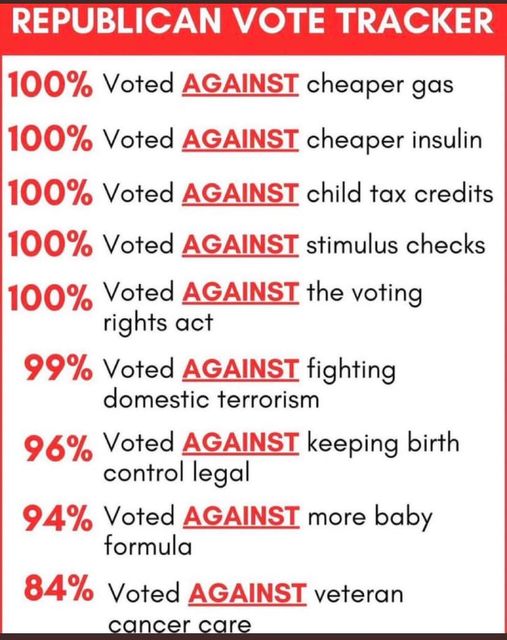
A REFLECTION OF REPUBLICAN CONCERN FOR.....YOU

A REFLECTION OF REPUBLICAN CONCERN FOR.....YOU

Republicans tout moral values and then spit on those values by their actions.

Leave a comment

NOW is the time.

NOW is the time.
NOW is the time.

Don't let this happen.  Stand up and be counted.

Leave a comment

FAILED....REPUBLICAN TRICKLE-DOWN ECONOMICS

FAILED....REPUBLICAN TRICKLE-DOWN ECONOMICS

What the Failure of Liz Truss’s Economic Agenda in the UK Can Teach the U.S.

By Sonali Kolhatkar

Americans, relieved that they were rid of Donald Trump and his incessant scandals, looked gleefully to their neighbors across the Atlantic as British Prime Minister Liz Truss resigned after a mere 45 days in office. Truss had the shortest term of any British prime minister in history, disgraced by the consequences of her own economic prescriptions. There is a lesson to be learned from Truss’s rise and rapid downfall that applies to the United States, a nation beset by similar economic troubles but with a very different governmental structure.

The main takeaway from Truss’s downfall is that tackling inflation by rewarding the rich is a fool’s errand. Fashioning herself after Margaret Thatcher, the godmother of conservative capitalism, Truss had hoped to join the ranks of former prime ministers Tony Blair and David Cameron as a champion of “trickle-down” policies.

A central idea favored by Thatcherites—one that may sound familiar to Americans—is that when ordinary people are struggling, leaders must ensure the rich get richer so that the crumbs of their excesses will trickle down to the poor. Going hand in hand with this is the aggressive deregulation of industries to free them from the fetters of any protective measures that could impact profit margins.

Here in the U.S., President Ronald Reagan promoted this ludicrous concept in the 1980s as perhaps the grandest grift of all time, overseeing massive tax cuts for the wealthiest Americans and an aggressive deregulatory agenda. According to the Center for American Progress, when “Reagan took office in 1981, the marginal tax rate for the highest income bracket was 70 percent, but that fell to just 28 percent by the time he left office.”

In spite of decades of evidence that trickle-down economics doesn’t work, Republicans, when in control of the U.S. Congress and the presidency, have aggressively pushed through the same policies. Recall the 2017 tax reform bill forced through the legislative process by then-Senate Majority Leader Mitch McConnell and signed into law by Trump. That bill continued what Reagan started by infusing cash at the very top in the form of tax cuts. It too, like its predecessors, failed.

Truss repackaged this same grift in the UK, with critics coining a new moniker for it: Trussonomics. Influenced by right-wing think tanks such as the Adam Smith Institute and the Institute of Economic Affairs, she pushed a “mini-budget” centered on major tax cuts for the wealthiest in Britain with no plan on how to compensate for the loss in revenues.

The Guardian’s economics correspondent Richard Partington explained that this triggered “a run on sterling, gilt market freefall and spooked global investors. Even the International Monetary Fund (IMF) intervened with a stunning public rebuke.” The British pound plummeted in value, and the Bank of England was forced to intervene by buying up bonds and raising interest rates. Eventually, members of Parliament began expressing enough loss of confidence in the new prime minister that Truss was forced to resign just over six weeks into her tenure.

Since the 1980s, both Republican and Democratic presidents in the U.S. embraced “Reaganomics,” in spite of critics repeatedly calling out the lunacy of enriching the wealthy to address poverty. By the time Joe Biden took office in January 2021, there was so much damage done that the new president felt moved to articulate that trickle-down economics doesn’t work. Biden repeated his criticisms as Truss took office, saying on Twitter in September 2022, “I am sick and tired of trickle-down economics. It has never worked.”

But talk is cheap, and another major lesson for Americans is that while it’s easy to find relief in our more stable system of government in which presidential elections are prescribed every four years, Britain’s less stable parliamentary system is far more responsive to popular will.

The best example of this—one that stands in stark contrast to the U.S.—is Britain’s National Health Service (NHS), a free, government-funded universal health care system that is the envy of Americans. In 1948, Aneurin Bevan, Britain’s then-health secretary, promoted the idea of a health care system that would serve all people. According to historian Anthony Broxton, Bevan pushed a parliamentary vote on the bill that would create the NHS, asking, “Why should the people wait any longer?”

Americans have waited and waited for a similar health care system. We are still waiting. A New York Times analysis explained how health care spending in the U.S. began getting out of control at the precise time when Reagan-era deregulation began. Decades of attempts to install a universal, government-funded free health care system in the U.S. have failed.

In an MSNBC op-ed, Nayyera Haq wrote, “in the nearly 250 years since the founding of the United States, American government has not followed Britain’s path of providing a universal health care system or welfare programs for the majority of the population.” Haq concluded, “The elevation of status quo over popular will has all but frozen the ability to respond to that will, weakening the American system far more than Truss’ tenure will destabilize Britain.”

While Americans can’t very well switch our government system into a parliamentary one, we do have midterm elections in just a few weeks. It turns out trickle-down economics is indeed on the ballot, and Republicans are using every means at their disposal to ensure its win.

The GOP has rigged elections in its favor via a cunning combination of gerrymandered districts, voting laws that thwart likely Democratic voters, and legislative control at the state level where electoral rules are decided. In Florida, Republican governor Ron DeSantis has embraced antidemocratic tactics to such an extent that he created a police force to arrest largely Black (and therefore likely-to-be-Democratic) voters who he claims are casting ballots illegally. In other words, Republicans have engineered a system of minority rule bordering on fascism.

Blowing wind into their sails is the corporate media, insisting that worries over inflation could help Republicans win majorities in both houses of Congress—in spite of decades of evidence that the GOP has a record of economic failures. It has become a central Republican talking point to inflate—pun intended—worries about rising prices, blame Democrats for inflation, and make the case for their own electoral victories. Economist Dean Baker criticized the media for “hyping inflation pretty much non-stop for the last year and a half.”

While polls show that relentless coverage of inflation has moved voters toward Republican candidates, few outlets are asking questions about the GOP’s plan to tackle inflation. House Republican leader Kevin McCarthy has published a rosy plan, very thin on specifics, to fix the nation’s economic woes if his party wins majorities. A one-page description of his plan includes a vague prescription to “bring stability to the economy through pro-growth tax and deregulatory policies.”

In other words, Republicans are yet again promising to deliver a wolf in sheep’s clothing. Call it Reaganomics, Thatcherism, or Trussonomics, trickle-down economics is the great lie that has failed time and again. If Truss’s spectacular fall should teach Americans anything, it is that it will fail again. Unlike the Brits, we’re likely to be stuck with the ill effects of such failure for a lot longer.

This article was produced by Economy for All, a project of the Independent Media Institute.

Author Sonali Kolhatkar is an award-winning multimedia journalist. She is the founder, host, and executive producer of “Rising Up With Sonali,” a weekly television and radio show that airs on Free Speech TV and Pacifica stations. Her forthcoming book is Rising Up: The Power of Narrative in Pursuing Racial Justice (City Lights Books, 2023). She is a writing fellow for the Economy for All project at the Independent Media Institute and the racial justice and civil liberties editor at Yes! Magazine. She serves as the co-director of the nonprofit solidarity organization the Afghan Women’s Mission and is a co-author of Bleeding Afghanistan. She also sits on the board of directors of Justice Action Center, an immigrant rights organization.

Leave a comment
  • 1
  • ...
  • 3
  • 4
  • 5
  • ...
  • 6
  • ...
  • 7
  • 8
  • 9
  • ...
  • 10
  • ...
  • 11
  • 12
  • 13
  • ...
  • 29

Women's Voices Media - Newsletter

Powered by follow.it

Search

Wit & Wisdom

Things are going to get a lot worse before they get worse.
Lily Tomlin
April 2026
Sun Mon Tue Wed Thu Fri Sat
      1 2 3 4
5 6 7 8 9 10 11
12 13 14 15 16 17 18
19 20 21 22 23 24 25
26 27 28 29 30    
 << <   > >>

XML Feeds

  • RSS 2.0: Posts
  • Atom: Posts
What is RSS?

Your Multimedia
This collection 2026 by Janice Jochum
Copyright 2019 United Activision Media, LLC
Creative Commons License
This work is licensed under a Creative Commons Attribution-NonCommercial 4.0 International License.
• Contact • Help

b2
Cookies are required to enable core site functionality.