FROM IMMIGRANT TO LATINEX CHAMPION
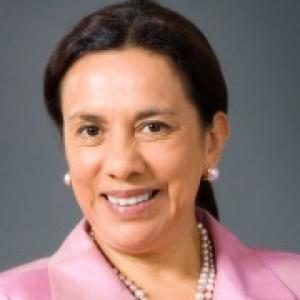
ANTONIA HERNANDEZ (1948 - ) According to Antonia Hernández, she “went to law school for one reason: to use the law as a vehicle for social change.” Decades later, she can claim numerous legal victories for the Latinx community in the areas of voting rights, employment, education, and immigration. From legal aid work, to counsel to the Senate Judiciary Committee, to head of a major civil rights organization, Hernández has used the law to realize social change at every turn.
Antonia Hernández was born in Torreón, Mexico in 1948 to Manuel and Nicolasa Hernández. Her father had been born in Texas, but his family returned to Mexico after government officials forced Mexican Americans to leave the U.S. during the Great Depression due to job shortages. Hernández was the oldest of seven children. When she was eight years old, her family moved to the Maravilla Housing projects in East Los Angeles, where her parents worked in chicken factories, manufacturing, and gardening. Hernández endured taunts of “mojada” (“wetback,” a pejorative term for Mexican immigrants to the U.S.) from her classmates and neighborhood children. Despite the taunting, Hernández worked hard as a child, both in school learning English and on the weekends, selling her mother’s tamales across East L.A. alongside her father. In the summers, the family members were all migrant workers, picking crops from farm to farm. Hernández became politically active at a young age with the support of her father, who drove her to civil rights and Chicano movement protests in the 1960s. Her determination to fight for racial justice would continue through all her future endeavors.
Hernández graduated from Garfield High School in East L.A. and attended East Los Angeles College before she was admitted to UCLA as part of an affirmative action program. There she earned her B.A. in History in 1970, as well as her J.D. at the UCLA School of Law in 1974. Soon after passing the California bar exam, Hernández became a U.S. citizen. Reflecting on her U.S. citizenship in 1985, Hernández told the Los Angeles Times "I love [this country] more than most because I don't take the rights and privileges of an American citizen for granted. I remembered there was a knot in my throat when I took the oath [of citizenship]."
Committed to working in civil rights law, Hernández began her career as a staff attorney with the Los Angeles Center for Law and Justice. There she worked on a class-action lawsuit (Madrigal v. Quilligan, 1978) that alleged the USC/Los Angeles County Medical Center conducted sterilization procedures on women who had just given birth and had not consented to the procedures. They lost in court, but the press attention the case garnered led the medical center and the state of California to enact reforms intended to prevent such violations in the future. Hernández then took a position as staff counsel to the Senate Judiciary Committee from 1979-1981, the first Latina ever to hold that position.
From the Senate Judiciary Committee, Hernández moved to the Mexican American Legal Defense and Educational Fund (MALDEF), where she served as Regional Counsel in Washington, D.C. In 1985, she became President and General Counsel of MALDEF. As President, Hernández directed the organization’s litigation efforts and advocacy programs as well as managed a multimillion-dollar budget and several field offices. MALDEF pursued important voting rights cases while under Hernández’s leadership. They filed federal suits in California, Texas, Illinois, Wisconsin, and Michigan that led to an end to gerrymandering and other discriminatory practices that prevented Latinx candidates from winning elections in those districts. MALDEF also defended The Voting Rights Act of 1965, which Congress expanded to cover Texas and other Southwestern states in 1975. These efforts included an amendment that explicitly outlawed discriminatory election practices and a provision that protected the rights of non-native English speakers. MALDEF also organized nationwide campaigns to promote Latinx participation in the 1990 and 2000 censuses, to better ensure equitable political representation for the Latinx community. Hernández led MALDEF’s legal pursuit of Latinx-majority voting districts across the country, most notably for the Los Angeles County Board of Supervisors (Garza v. County of L.A., 1990) and a Chicago-area congressional district (King v. Illinois State Board of Elections, 1995).
Voting rights were not the only cause that Hernández took up while leading the civil rights organization. MALDEF also played a significant role in the 1994 battle against Proposition 187 in California, which barred undocumented immigrants from accessing public education, hospitals, and other services. The courts eventually struck down most of the act’s provisions. MALDEF won key victories in Texas and California to remedy racially discriminatory financing in public school systems. MALDEF also fought for Latinx students with lawsuits to ensure bilingual and multicultural education as well as greater access to higher education. Immigration and education issues came together in MALDEF’s successful campaigns for the rights of undocumented students in California to attend state universities; pay the same tuition as other state residents; and access scholarships in lieu of state and federal financial aid for which they were ineligible.
In 2004, Hernández accepted the position of President and Chief Executive Officer of the California Community Foundation (CCF), a philanthropic organization devoted to improving the lives of those in L.A. County. During her leadership of the organization, CCF has granted nearly two billion dollars to housing, education, health, and immigration-related initiatives.
Hernández is a fellow of the American Academy of Arts and Sciences and the American Law Institute. She has received honorary degrees from Whittier College (1998) and Brown University (2016).
Hernández is married to fellow attorney Michael Stern, whom she met while clerking for the California Rural Legal Assistance Office in Santa Maria as a law student. Together they have three children.
MLA – Brandman, Mariana. “Antonia Hernández.” National Women’s History Museum, 2020. Date accessed.
Chicago – Brandman, Mariana. “Antonia Hernández.” National Women’s History Museum. 2020. www.womenshistory.org/education-resources/biographies/antonia-hernandez
Spanish Translation Provided By: NBCUniversal Telemundo
Photo Credit: Markle Foundation, licensed under CC BY-SA 4.0
Works Cited
“Antonia Hernandez: President & Chief Executive Officer.” California Community Foundation. Accessed November 27, 2020. https://www.calfund.org/about-ccf/ccfstaff/presidents-office/
Espino, Virginia. “Hernández, Antonia (1948- ).” In Latinas in the United States: A Historical Encyclopedia, edited by Vicki Ruíz and Virginia Sánchez Korrol, 317. Bloomington: Indiana University Press, 2006.
“Honoring The Public Service of Antonia Hernández.” Press Release by Congresswoman Lucille Roybal-Allard, California’s 40th Congressional District. March 31, 2004. Accessed November 25, 2020. https://roybal-allard.house.gov/news/documentsingle.aspx?DocumentID=129815
“Oral Histories: Antonia Hernandez.” CSPAN/American Bar Association’s Women Trailblazers in the Law Project. October 22, 2007. Accessed November 17, 2020. https://www.c-span.org/video/?294199-1/antonia-hernandez-oral-history-interview
Ramos, George. "New Head of Mexican American Legal Defense Fund: Antonia Hernandez Not Afraid to Say She Loves U.S." Los Angeles Times. August 5, 1985.
Ruiz, Vicki L. From Out of the Shadows: Mexican Women in Twentieth-Century America. New York, NY: Oxford University Press, 2008.
Sandoval, Maria, Julia Victor, and Claudia Cabrera. “Antonia Hernandez.” SJSU WOMS 20. Women of Color. Accessed November 27, 2020. http://prof.chicanas.com/20/?page_id=629
“Sisters in Suffrage.” National Organization for Women. Accessed November 25, 2020. https://now.org/sisters-of-suffrage/
Stewart, Jocelyn Y. "COVER STORY; THE ADVOCATE; as the President of the Mexican American Legal Defense and Educational Fund, Antonia Hernandez Speaks for Millions: [Home Edition]." Los Angeles Times. Sep 12, 1999.