The first woman allowed to argue Supreme Court cases
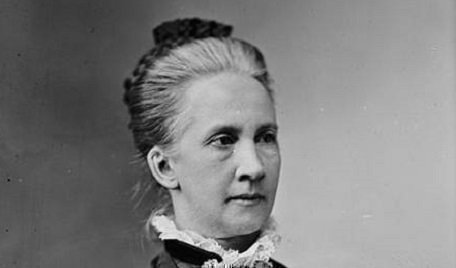
On February 15, 1879, President Rutherford B. Hayes signed a new law that would admit women as members of the Supreme Court bar and allow them to submit and argue cases at the high court.
Suffragette, teacher, lawyer and presidential candidate Belva Lockwood championed that cause with Congress after the Supreme Court ruled that women – and specifically Lockwood – could not practice law before it. In November 1876, Chief Justice Morrison Waite curtly replied to Lockwood’s request to be admitted to the Supreme Court bar. “By the uniform practice of the Court from its organization to the present time, and by the fair construction of its rules, none but men are permitted to practice before it as attorneys and counselors,” Waite said. The Chief Justice added the Court wouldn’t change its mind unless “required by statute.”
In most cases, state courts also didn’t allow women as lawyers to argue cases at the state-court level. The Supreme Court in an 1872 opinion in Bradwell vs. Illinois confirmed the ability of Illinois to block women from its state bar. Myra Bradwell, a recent law school graduate, asked the Supreme Court to intervene, citing the 14th Amendment’s Privileges or Immunities Clause.
Justice Samuel Miller, citing the recent Slaughterhouse Cases, said the clause didn’t apply to the ability of a state to regulate its own conduct. “The right to control and regulate the granting of license to practice law in the courts of a state is one of those powers which are not transferred for its protection to the federal government,” Miller said.
Justice Joseph Bradley’s concurring opinion went much farther, stating that women weren’t fit to argue Supreme Court cases or even become lawyers. “Man is, or should be, woman’s protector and defender. The natural and proper timidity and delicacy which belongs to the female sex evidently unfits it for many of the occupations of civil life,” Story said. “The paramount destiny and mission of woman are to fulfill the noble and benign offices of wife and mother. This is the law of the Creator.”
Undaunted, Lockwood spent three years after her 1874 rejection lobbying Congress and former President Ulysses Grant (who had presented Lockwood with her law degree) for a law that would force the Supreme Court to recognize the right of women to appear before it. President Hayes signed “An act to relieve certain legal disabilities of women,” which read that “any woman who shall have been a member of the bar of the highest court of any State or Territory or of the Supreme Court of the District of Columbia for the space of three years, and shall have maintained a good standing before such court, and who shall be a person of good moral character, shall, on motion, and the production of such record, be admitted to practice before the Supreme Court of the United States.”
Lockwood had been practicing law in the District of Columbia and qualified as the first female attorney to appear before the Court, in the 1880 case Kaiser v. Stickney. Lockwood spoke for about 20 minutes in court. Lockwood didn’t prevail in that case but won her second and final case at the Supreme Court in 1906. (She also ran for president twice on the National Equal Rights Party ticket.
Scott Bomboy is the editor in chief of the National Constitution Center.
The Constitution Daily
February 15, 2020 by Scott Bomboy
Editor in chief of the National Constitution Center
#womensvoicesmedia
#womensvoices
#mediawomans